
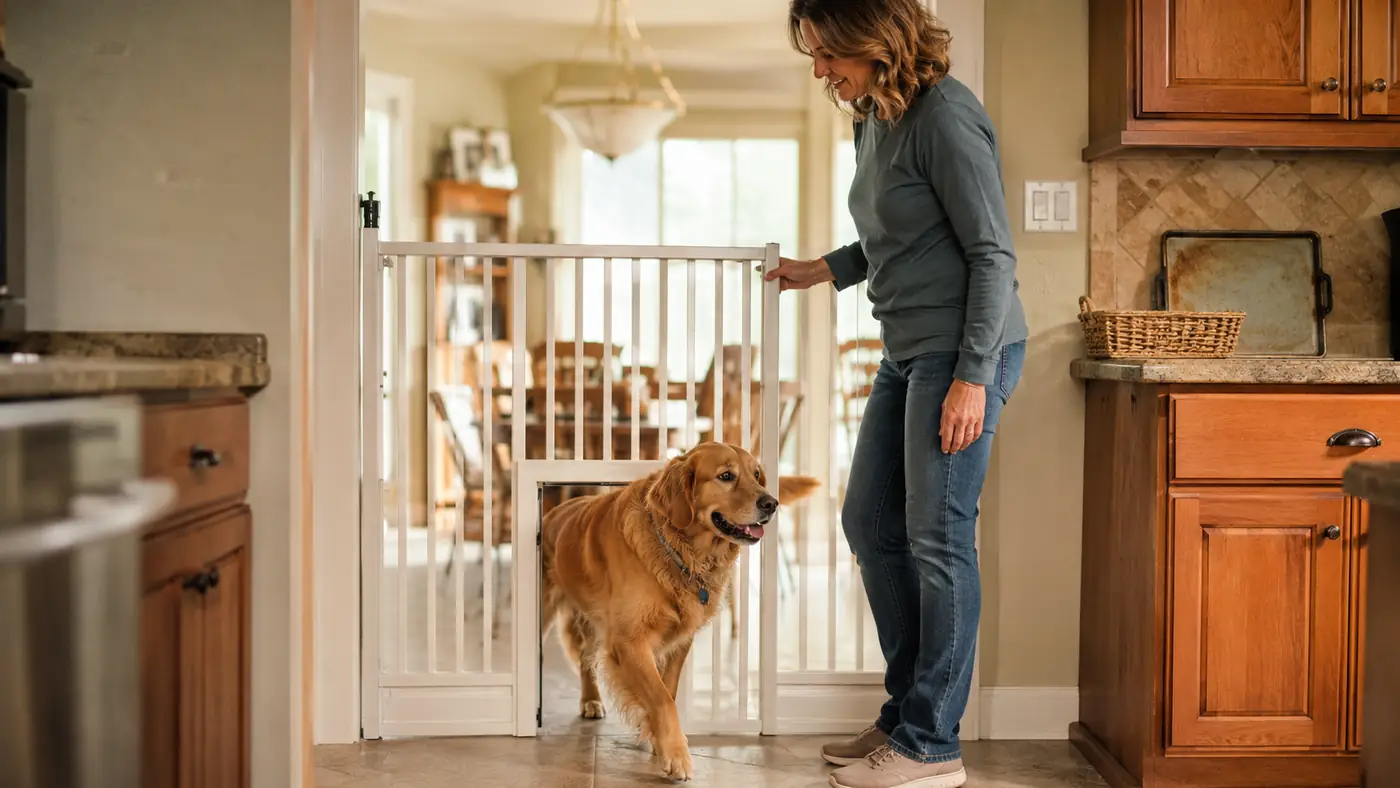
We have used a lot of baby gates and pet gates in fifteen years of fostering out of our house in central Ohio, and most of them ended up in the garage within a few months, warped, wobbly, or just annoying enough that we stopped bothering to close them every time we walked past. The Carlson Extra Wide Walk-Through Gate with the small pet door has been the one exception to that pattern. It has lived in our kitchen doorway for a full year now, holding back a rotating cast of foster dogs while letting our senior cat come and go through the cutout at the bottom, and I want to walk through exactly what a year of real daily use looks like, not just the unboxing photos most reviews stop at.
Our doorway between the kitchen and the living room measures just over 34 inches, which ruled out most standard 29 to 32 inch pet gates before I even started shopping seriously. The Carlson gate's extended range, 29.5 to 36.5 inches, was the actual reason it made my shortlist over the cheaper options I kept scrolling past. We have three permanent residents, Duke, our eleven-year-old yellow Lab, Ranger, our five-year-old mixed breed who treats every open doorway like a starting line, and Biscuit, our senior cat, plus whatever foster dog is staying with us at any given time. This gate has had to hold up against all of them, every single day, in every season, for a year.
The Quick Verdict
A genuinely sturdy, wide-doorway gate that has survived a year of daily foster-dog traffic without loosening, warping, or needing to be replaced, though the walk-through door swing has developed a slight squeak and the small pet door only works for smaller animals.
Amazon Check Today's Price →Stop stepping over a gate that's too short for your doorway.
If your doorway is wider than a standard gate but you don't want to drill into your trim, a pressure mounted gate with real extended reach solves both problems at once the way this one did for us.
Amazon Check Today's Price on Amazon →How I've Used It
The gate lives between our kitchen and living room, closed most of the day, mainly to keep Ranger out of the kitchen while I'm cooking and to give whichever foster dog is newest a calm space to decompress without free run of the whole house on day one. Duke mostly ignores it now, but Biscuit uses the small pet door cutout at the bottom multiple times a day to move between rooms without anyone having to open the whole gate for her.
Setup took me about fifteen minutes the first time, mostly because I was double checking the pressure mount pads were seated flush against our door trim before locking the tension bar. There is no drilling required at this width, which mattered to me because our house is a hundred years old and I did not want to put screw holes into original trim for a piece of pet gear. Once it was tensioned, it stayed put, and I have only had to give the tension bar a quarter turn once in twelve months, closer to the six month mark when I noticed a very slight wiggle.
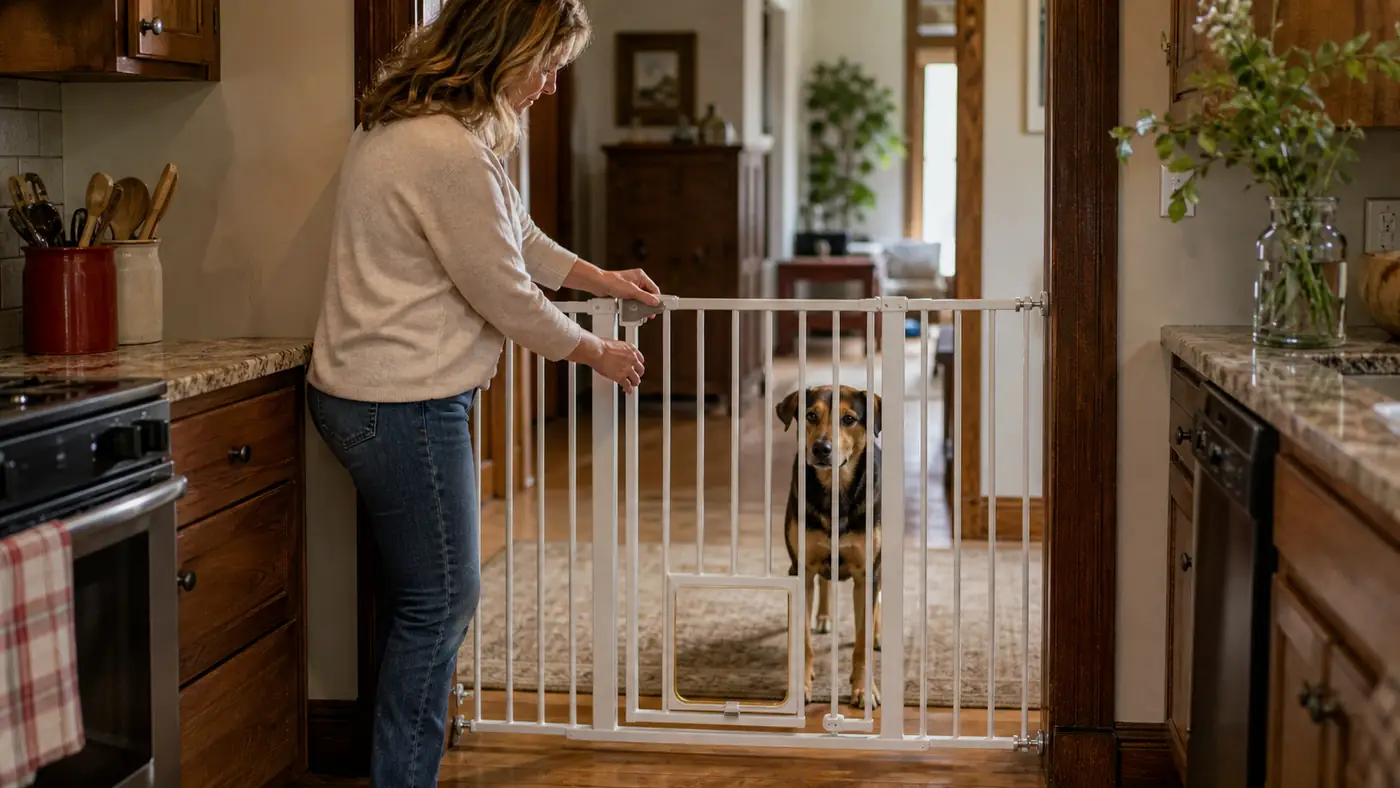
What sold me on daily use, though, is the walk-through door built into the panel. I do not have to step over the gate or unlock the whole thing every time I need to carry a laundry basket or a bag of dog food from one room to the other. I push the door open with a hip or a free hand, walk through, and it swings shut and latches on its own behind me. After a year, I genuinely could not go back to a gate without that feature.
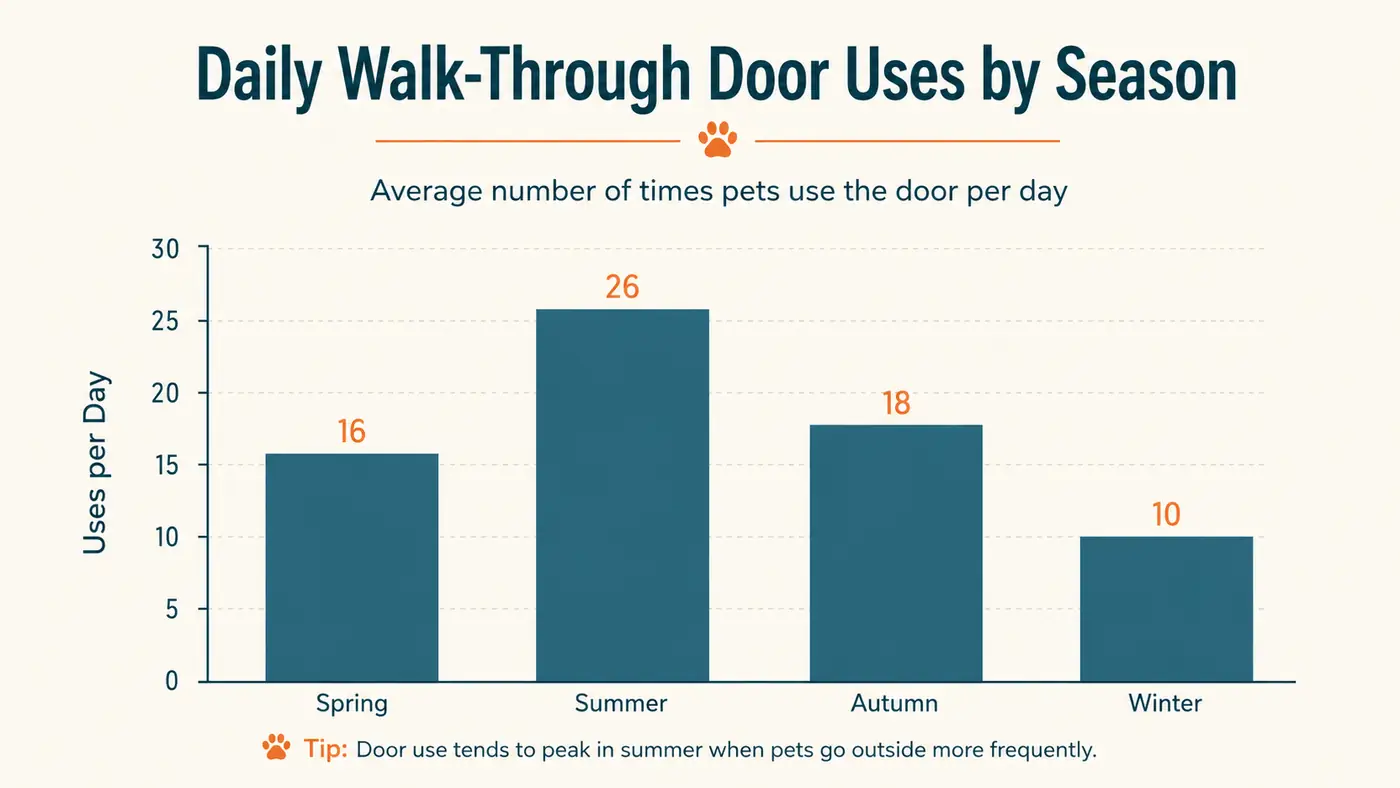
Weather and season changed the routine more than I expected going in. Ohio winters mean a lot more indoor time with all three animals underfoot, and that's when the gate earns its keep the most, giving Ranger a designated zone during the chaotic morning feeding rush instead of letting him crowd the stove. Summers, with more foster dogs coming through for transport and more doors opening and closing as everyone comes in from the yard, the gate has seen the heaviest daily traffic of the year, and it has not shown any different wear pattern between the two seasons.
The Walk-Through Door, Used Daily
The walk-through door is, without question, the reason this gate earned a permanent spot in our house instead of getting folded up and shoved in a closet like three other gates before it. It swings one way, latches with a simple push-button mechanism at the top, and locks high enough that none of our dogs have ever figured out how to bump it open, even Ranger, who has opened cabinet latches with his nose before.
I use it probably fifteen to twenty times a day between cooking, laundry, letting the dogs out to the yard, and just moving through the house normally. Over a year that adds up to somewhere around six thousand open-and-close cycles, and the hinge mechanism has held up to that without failing. It has gotten slightly squeakier since about month eight, which a drop of household oil fixed in under a minute, and that is the only maintenance it has needed.
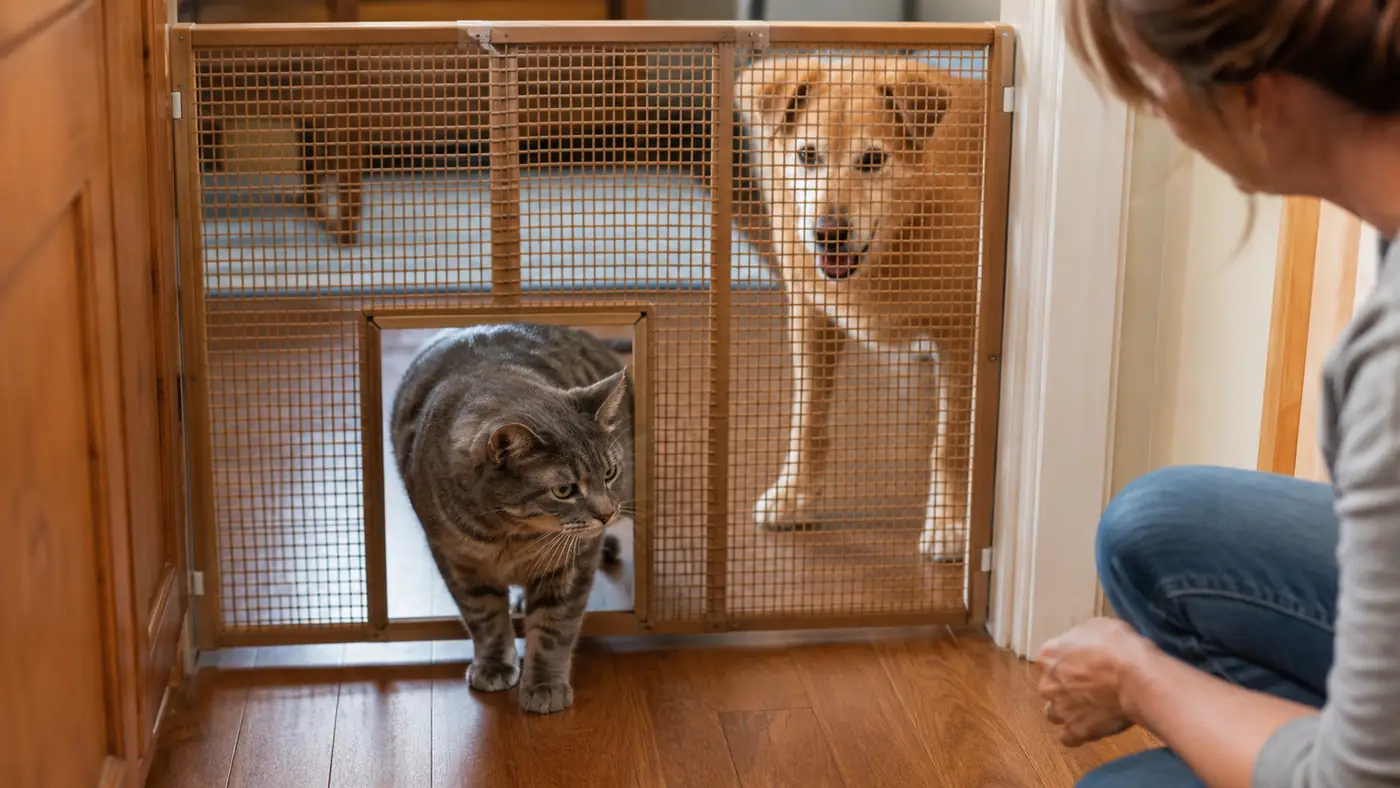
The small pet door at the bottom is the feature I was most skeptical about when I ordered it, and it has genuinely earned its place. Biscuit, who is fourteen and not interested in jumping over anything anymore, pushes through it dozens of times a day without any training from me. It is sized for a cat or a very small dog, not for Duke or Ranger, so it has never undermined the gate's actual job of containing our larger dogs.
A Year of Foster Dogs Testing Every Hinge
Between our own three animals, we have had eleven foster dogs pass through this house over the last year, ranging from a six-pound Chihuahua mix to a seventy-pound shepherd mix recovering from a leg injury. Every single one of them has tested this gate in some way, whether that was pawing at the mesh panel, leaning their full body weight against it, or in one memorable case, a foster puppy who tried to chew the bottom corner for about a week straight before losing interest.
The mesh panel has held up better than I expected against the chewing and the paw scratching. There is some visible wear where that puppy worked on the corner, a few small nicks in the coating, but nothing has torn through, and the structural frame underneath is untouched. I have leaned my own body weight against the walk-through door more than once while carrying an armful of laundry, and it has never buckled or popped out of the pressure mount.
The one thing I did not fully anticipate was how often the gate would get bumped by bigger dogs at full speed. The seventy-pound shepherd mix hit it running twice in his first week with us, both times chasing a tennis ball that got away from him, and both times the gate held its ground and stayed tensioned. That kind of impact is exactly the scenario where a cheaper pressure mounted gate tends to pop loose from the door frame, and this one did not budge either time.
Cleaning It and Keeping It Looking Presentable
A year of foster dogs means a year of muddy paws, drool on the mesh, and the occasional accident right at the base of the gate during a stressful first night with a new foster. I wipe the whole panel down with a damp cloth about once a week, and for the mesh specifically I use a soft brush with a little dish soap when it gets visibly grimy, which happens more in the muddy months than in summer.
The frame itself has never needed anything beyond a wipe down. It has not rusted, and the finish has not chipped or peeled anywhere except that small chewed corner. I was honestly bracing for the tan finish to look dingy and gray by now given how much traffic passes through this exact spot every day, but standing in front of it right now, it still looks close to how it did the week we set it up.
What I Looked At Before Choosing Carlson
Before I bought this gate, I seriously considered a hardware mounted gate that screws directly into the door frame. Those tend to be sturdier in theory, and for a household with only calm, well trained dogs I would probably lean that way. But we swap animals in and out constantly, and I did not want to be drilling new holes or patching old ones every time our foster situation changed or we needed to move a gate to a different doorway.
I also looked at a couple of cheaper standard-width gates and tried to make one work with a wood extension panel a friend suggested. That setup felt flimsy the moment I tested it, and I could see the extension flexing under light pressure before I even installed it permanently. Given that our doorway needed the extra width anyway, buying a gate actually built for that range instead of jury-rigging a narrower one made a lot more sense once I compared the two side by side.
The last thing I weighed was a freestanding pen-style gate that does not mount to anything at all. Those are more flexible about placement, but every version I looked at seemed easy for a determined dog to shove out of position, and Ranger absolutely would have found that gap within a day. The pressure mounted, doorway-specific design ended up being the better fit for a house where the gate genuinely needs to hold its position under real pressure, not just sit there decoratively.
What I Liked
- Extended 29.5 to 36.5 inch range fit our wider-than-standard doorway without an extension panel
- Walk-through door has held up to roughly six thousand open-close cycles over a year without failing
- Pressure mount has needed only one quarter-turn adjustment in twelve months
- Small pet door lets our senior cat move freely without opening the whole gate
- Survived two full-speed impacts from a seventy-pound foster dog without popping loose
- Tan finish still looks close to new after a year of daily wiping down
- No drilling required, which mattered in our older house
Where It Falls Short
- Walk-through door developed a mild squeak around month eight, fixed with a drop of oil
- Small pet door only works for cats or very small dogs, not a mid-size dog
- Mesh panel shows a few small nicks from a chewing foster puppy, though nothing structural
- Pressure mount setup means it is not meant for a determined, extra-large dog leaning on it constantly
I have gone through enough pet gates in fifteen years of fostering to know the ones that make it past month three. This is the first one that made it to a full year and I still reach for it without thinking twice.
Who This Is For
This gate makes the most sense for households with a doorway wider than the standard 29 to 32 inch range who do not want to drill into their trim, and for anyone who needs to walk through a gate multiple times a day without unlatching the entire thing. It is also a strong pick for multi-pet homes like ours, where a smaller cat or dog needs a way through that a bigger dog cannot use, since the small pet door solves that without any training or extra hardware.
Who Should Skip It
If you have a very large, determined dog who regularly leans or throws their full body weight against barriers, or a doorway situation where a permanent, unmovable barrier matters more than flexibility, a hardware mounted gate screwed into the frame is probably the safer long-term choice. Owners hoping the small pet door will work for anything bigger than a small dog or a cat should also look elsewhere, since it is genuinely sized for smaller animals only.
A year in, it's still the first thing we set up for a new foster dog.
Eleven foster dogs, one determined cat, and daily use later, this gate has earned its spot in our kitchen doorway. Check today's price before deciding if it fits your doorway too.
Amazon Check Today's Price on Amazon →