
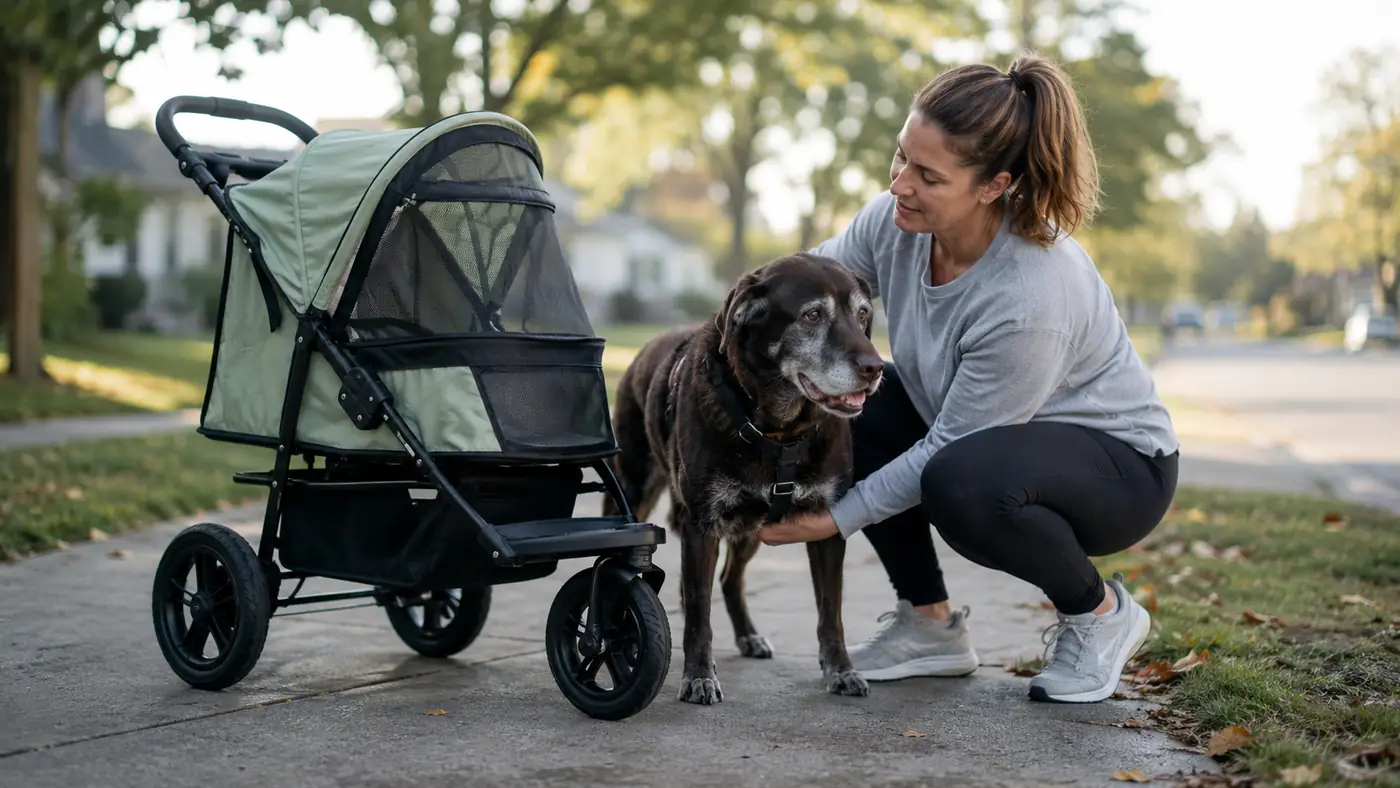
Duke is my twelve-year-old yellow Lab mix, and by the time he turned eleven his walks around the block had shrunk from a full mile to about the length of our driveway before his back hip started hitching. I could have just accepted shorter and shorter walks as the new normal, the way a lot of senior dog owners do, telling myself that a slow ten-minute loop was still a walk. Instead I built a routine around our BestPet stroller that lets Duke use his own legs for as long as they hold up, then finishes the walk riding instead of turning around early. Six months in, he's back to thirty-plus minutes outside almost every day. Here's exactly how I structured it, step by step.
This isn't really an article about a stroller. It's about the actual mechanics of walking a dog whose legs can't do the whole job anymore, whether that's arthritis, hip dysplasia, a slow recovery from surgery, or just plain old age catching up. The stroller happens to be the tool that makes the plan work, but the plan itself is what matters: know your dog's real limit, walk to it, then extend the outing instead of ending it. I've used this same approach with fosters who came through my house in Ohio with unknown mobility histories, not just with Duke, and the underlying steps stayed the same no matter which dog I was working with.
Duke stopped walking a mile. He never stopped wanting to.
The BestPet 3-Wheel Stroller is the tool I built this whole routine around, light enough to push one-handed, roomy enough for a seventy-plus pound Lab mix, and affordable enough that trying it isn't a real gamble. If your dog's legs are quitting before their curiosity does, this is where I'd start.
Amazon Check Today's Price on Amazon →Step 1: Find Your Dog's Real Walking Limit, Not the One You Wish They Had
Before you can build a walk-then-ride routine, you need an honest number, not a hopeful one. For a few days, walk your normal route and watch closely for the first sign your dog is struggling rather than waiting until they physically stop. That first sign is usually subtle: a hitch in the back leg, a slight lag behind your pace, sniffing longer than usual at a fire hydrant because they're stalling, or just a general heaviness in how they're moving compared to the first block. Note the distance or the number of houses where that shift happens. That's your dog's real limit today, not the distance you remember them covering two years ago, and it's almost always shorter than you'd guess if you're only watching for the obvious signs.
With Duke, that number turned out to be about three or four houses on an average morning, sometimes less on cold days when his hip stiffens up overnight. I tracked it for about a week using nothing fancier than counting mailboxes, and the number was remarkably consistent once I stopped assuming he could push through the way he used to. Fosters like Otis and Pearl came through with completely unknown mobility histories, so I ran the same three-day test on each of them before deciding how far to plan our walks, and it took the guesswork out of what could have been a lot of trial and error.
Weather changes this number more than people expect. A dog who comfortably walks eight houses on a mild afternoon might only manage three on a cold, damp morning when joints are stiffer. Build in a little flexibility rather than locking in one fixed distance, and check the number again every few weeks, because mobility with senior dogs rarely stays flat. It drifts, usually downward, and your plan should drift with it.
Step 2: Get Your Dog Comfortable With the Stroller Before You Need It Mid-Walk
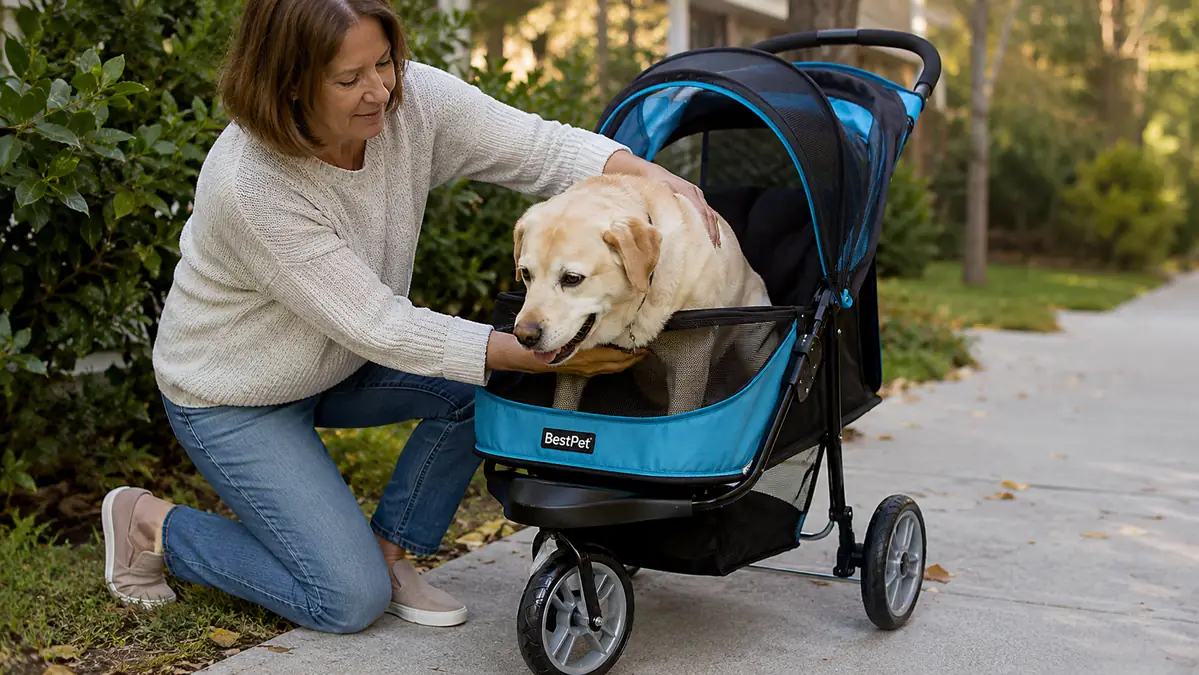
Don't wait until your dog is exhausted mid-walk to introduce the stroller for the first time. Set it up in the driveway or yard a few days beforehand, unzip the mesh dome, and let your dog sniff around it with no pressure and no expectation of getting in. Toss a few treats near the wheels and inside the compartment so the stroller starts registering as something good rather than something strange that shows up right when the walk gets hard. This single step prevents most of the resistance people run into when they try to combine walking and riding for the first time, and it costs you nothing but a few minutes and a handful of treats.
Once your dog is relaxed around the stroller sitting still, practice the actual lift a handful of times in a low-stakes setting, not on a busy sidewalk with cars going by. Lift, let them sit for thirty seconds, lift them back out, treat, done. The BestPet stroller's mesh compartment unzips easily one-handed once you've done it a few times, which matters when you're managing a leash and a dog who's already a little tired at the same time out on an actual walk.
Duke took about two weeks before he stopped whining every time another dog passed us while he was riding. That's normal. He wasn't afraid of the stroller itself, he just didn't love watching other dogs get to keep walking while he sat still. By week three he'd connected the stroller with still getting to finish the walk instead of being cut short, and the whining stopped almost overnight.
Step 3: Walk Out, Ride Back, or the Other Way Around
The actual routine is simple once the first two steps are done. Let your dog walk the first stretch on their own leash for as long as they're moving comfortably, using the limit you found in step one as your rough guide. The moment you see that hitch or lag show up, stop, lift them into the stroller, and keep the walk going instead of turning around. Your dog still gets fresh air, new smells, and the same loop around the block, they just finish it from the stroller instead of missing out on the second half entirely. Keep the leash clipped on even while they're riding, both for safety at crossings and so the transition back to walking feels seamless.
I flip the order on the way home. Duke rides out to the far point of our loop, and I let him walk himself back up the driveway instead of being lifted out of the stroller in front of the neighbors. It's a small thing, but ending the walk on his own four legs seems to matter to his sense of normalcy, and it means he isn't associating the stroller with the walk ending, only with the middle part being easier.
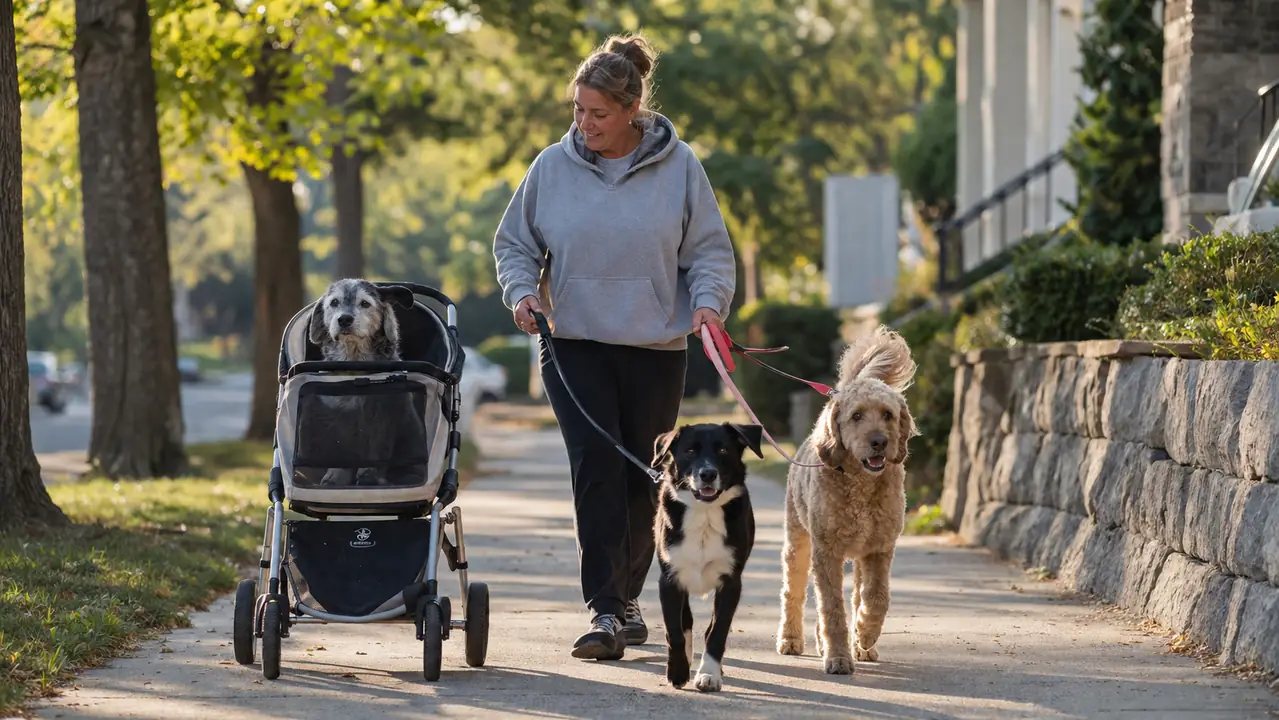
If you're managing more than one dog, this structure earns its keep fast. I walk Duke, Ranger, and Gus together most mornings, all three on the same outing, with Duke riding for the back half while Ranger and Gus stay on a double leash beside me. Before the stroller, I was starting to leave Duke home and walk the other two without him, which felt terrible every single time I did it.
Step 4: Build a Loose Schedule Instead of Deciding Fresh Every Morning
Once the walk-then-ride pattern is working, turn it into a routine rather than a decision you make fresh every morning. Dogs read consistency as safety, and a senior dog who knows the walk is coming, roughly the same time, roughly the same shape, tends to relax into it faster than one who's guessing whether today is a full walk, a short walk, or no walk at all.
Keep the stroller staged somewhere you'll actually use it, not folded up in the back of a closet. Mine lives standing up in the garage corner, ready to grab on the way out the door. The lower the friction to bring it, the more likely you are to actually use it on the mediocre days instead of only on the obviously bad ones, which is exactly when it earns its keep the most. A stroller that takes five minutes to dig out and unfold quietly turns into a stroller that stays parked, so keep it ready to go rather than tucked away.
On genuinely good days, let your dog walk further before you switch to the stroller, and on stiff or rainy days, load them up sooner. The schedule stays the same, the ratio of walking to riding just shifts. That flexibility is the whole point. You're not replacing the walk, you're protecting it from getting cancelled entirely on the days your dog's body says no.
Step 5: Re-Check the Numbers Every Few Weeks and Adjust
Senior mobility rarely holds steady for long, so repeat the simple baseline test from step one every few weeks. Count the houses or minutes again on a normal day and compare it to where you started. A slow, gradual decline is expected and just means shifting more of the walk to the stroller over time. A sudden, sharp drop is worth a call to your vet rather than just adjusting the routine around it on your own.
Duke's spring checkup was actually what pushed me to buy the stroller in the first place, after his vet flagged how much his daily activity had quietly shrunk. Six months later at his fall recheck, his muscle tone in the back end had noticeably improved, not because the stroller strengthened anything on its own, but because he was covering more total ground and using his legs for the parts he could still handle. I mentioned the walk-then-ride routine to his vet at that appointment, mostly out of curiosity, and got a genuinely enthusiastic response about keeping any weight-bearing movement in the plan for as long as possible.
The number that mattered most to me wasn't distance or minutes, it was that Duke kept getting to be part of the pack walk with Ranger and Gus instead of getting left home. That's the actual goal of all five steps, not turning your dog into an athlete again, just keeping them included in the walk for as long as you both can manage it.
What Else Helps
A few small things made this easier beyond the stroller itself. A quick nail trim and some non-slip traction on hardwood floors gave Duke more confidence in the legs he was still using, since slipping even once tends to make a stiff dog more hesitant the next time out. I also moved his stroller-assisted walk to mornings, since stiffness is almost always worse right after a long nap or overnight rest, and saved the shorter, slower loop for evenings when he's already loosened up. And if your dog is carrying extra weight on top of joint issues, even a modest reduction takes real pressure off the same legs you're trying to preserve, worth a conversation with your vet before you build the rest of this routine around it. A soft harness instead of a plain collar also gave me a lot more control when Duke was tired and starting to wobble, without putting any pressure on his neck during the last few steps before the stroller comes out.
The stroller didn't give Duke his legs back. It just stopped his legs from deciding how much of the walk he got to finish.
Five steps. No dramatic breakthrough. Just a dog who still gets his walk.
If your senior dog's legs are quitting before their curiosity does, the BestPet 3-Wheel Stroller is the tool that made this whole routine possible for Duke, and for every foster who's come through my house since. It's light, it's affordable, and it turns a shrinking walk back into a full one.
Amazon Check Today's Price on Amazon →