
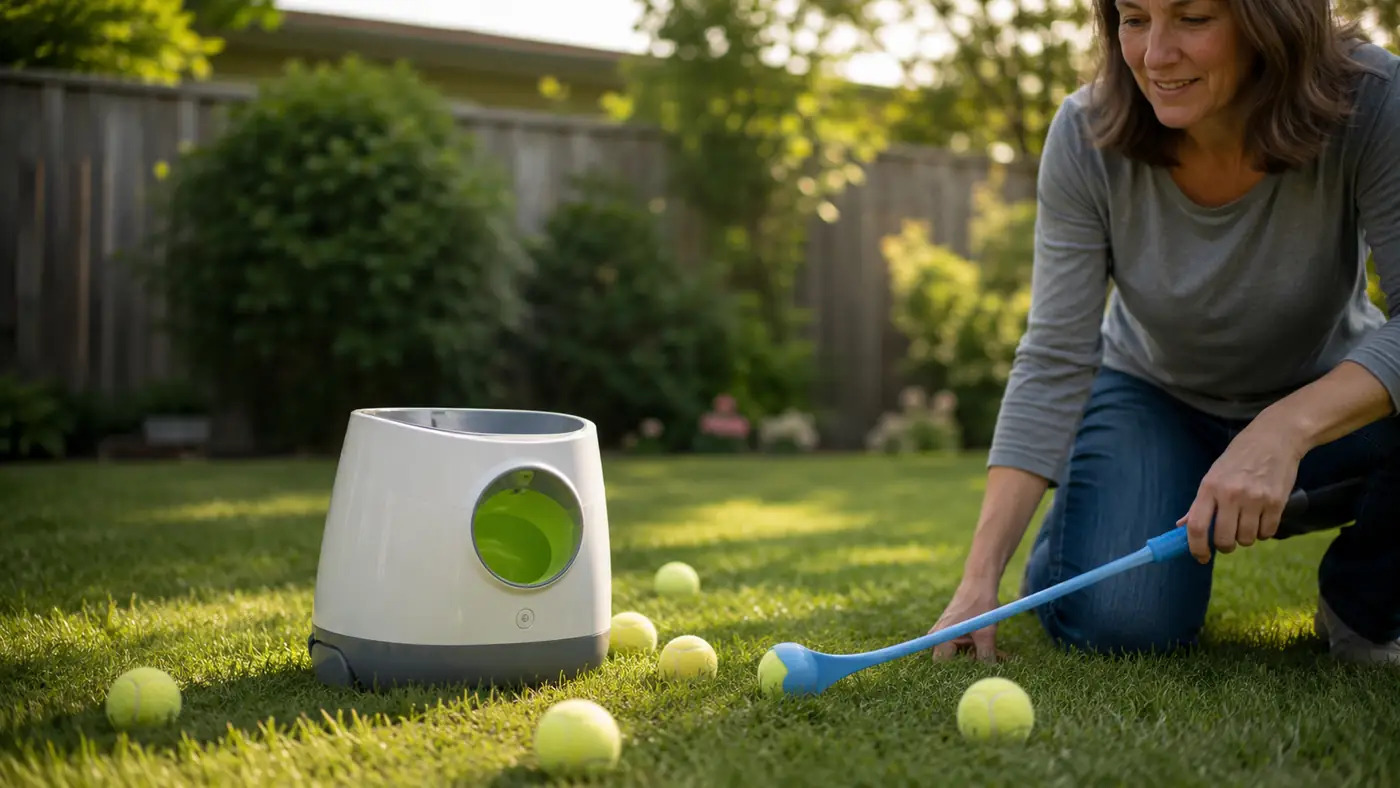
Short answer: if you have a genuinely high-energy dog who needs fifteen or twenty solid minutes of fetch every single day and your throwing arm gives out before your dog does, the MEKAPLE Automatic Dog Ball Launcher is worth the money. If your dog tires out after ten throws, or you actually enjoy standing in the yard with a ball in hand, manual fetch with a regular ball and a plastic chuck-style thrower does the job for a fraction of the price and doesn't need batteries. I've done the math on both, and it comes down to how much fetch your specific dog actually needs, not which option sounds fancier.
I run a foster rescue setup out of Ohio, fifteen years in now, and my current household is two dogs, Duke and Ranger, plus a senior cat named Biscuit who watches all of this from a windowsill with visible disdain. My third dog, Gus, is the reason I own the MEKAPLE launcher at all. He's a young, high-drive mix who came to me as a foster and never left, and by the time he was six months old my shoulder had started aching from the sheer volume of throws he demanded before he'd even think about slowing down. I bought the MEKAPLE launcher specifically to solve that problem, and I've run it side by side with plain old manual fetch enough times now to know exactly where each one earns its keep.
| MEKAPLE Automatic Ball Launcher | Manual Fetch (Ball + Thrower) | |
|---|---|---|
| Upfront cost | Mid-range for the launcher plus 15 mini tennis balls included | Very cheap for a plastic chuck-style thrower and a few tennis balls |
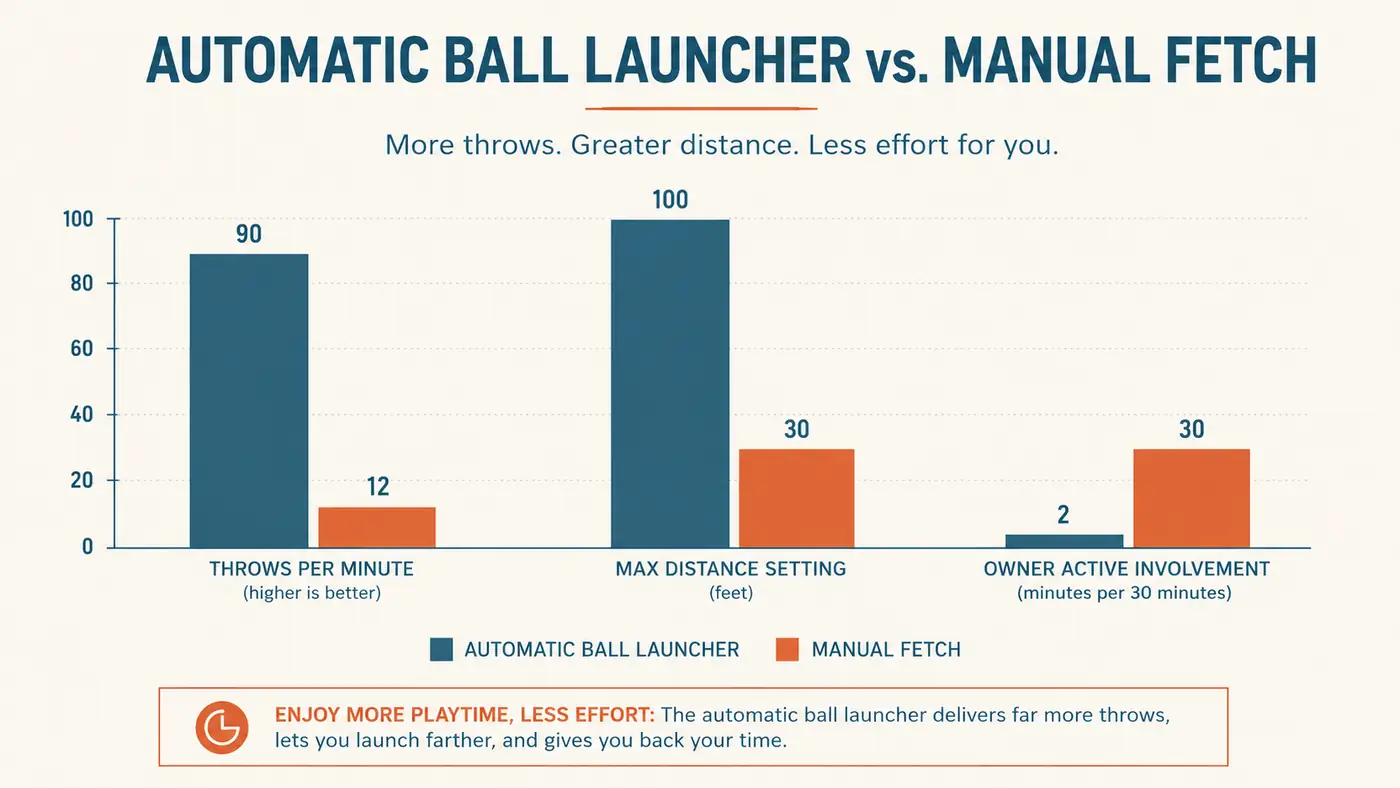
| Throws per minute | Fires roughly every 6 to 8 seconds once Gus drops the ball back in, no rest for either of us | Limited by how fast I can bend, retrieve, and wind up, realistically one throw every 15 to 20 seconds |
| Distance settings | Three fixed distance settings, roughly 10, 20, and 30 feet, randomized so the dog can't anticipate the angle | Entirely dependent on my arm and the thrower, can vary from 15 to 50 feet but gets shorter and sloppier as I tire |
| Owner involvement | Minimal once it's set up, mostly supervising and refilling balls from a lawn chair | Full physical participation the entire session, this is the workout too |
| Power source | Rechargeable battery, runs a full session on one charge in my experience | None needed, works forever with zero maintenance |
| Portability | Needs a flat surface and an outlet nearby for charging, not something you toss in a bag for a trip to the park | Fits in a jacket pocket, works anywhere including hiking trails and hotel courtyards |
| Best for | High-drive dogs who need repetitive, sustained fetch sessions longer than a human can realistically throw | Moderate-energy dogs, multi-dog households where one thrower can't keep up with everyone, or any outing away from home |
| Noise and setup | Motor makes a mechanical whirring sound with each launch, some dogs need a few sessions to stop flinching at it | Silent, no learning curve for the dog at all |
Where the MEKAPLE Launcher Wins
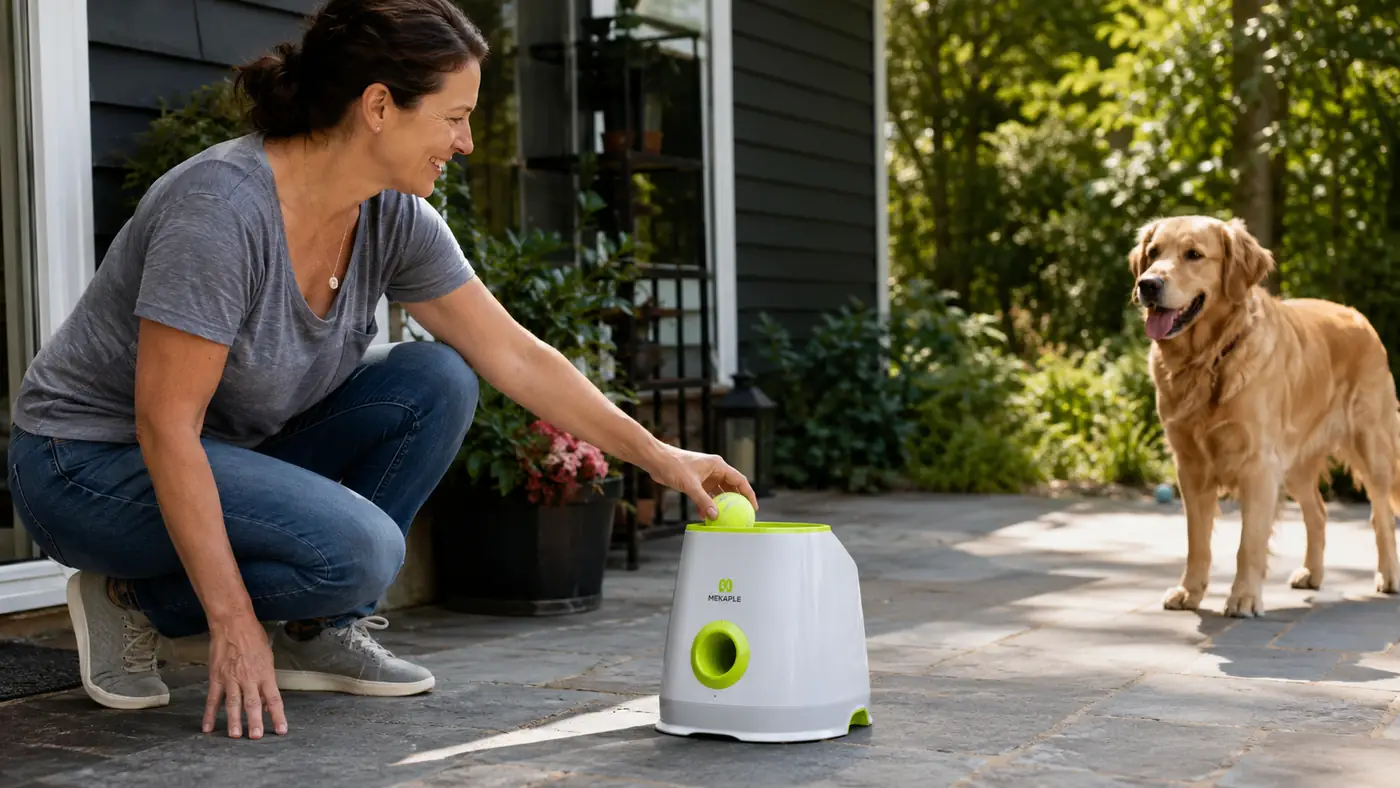
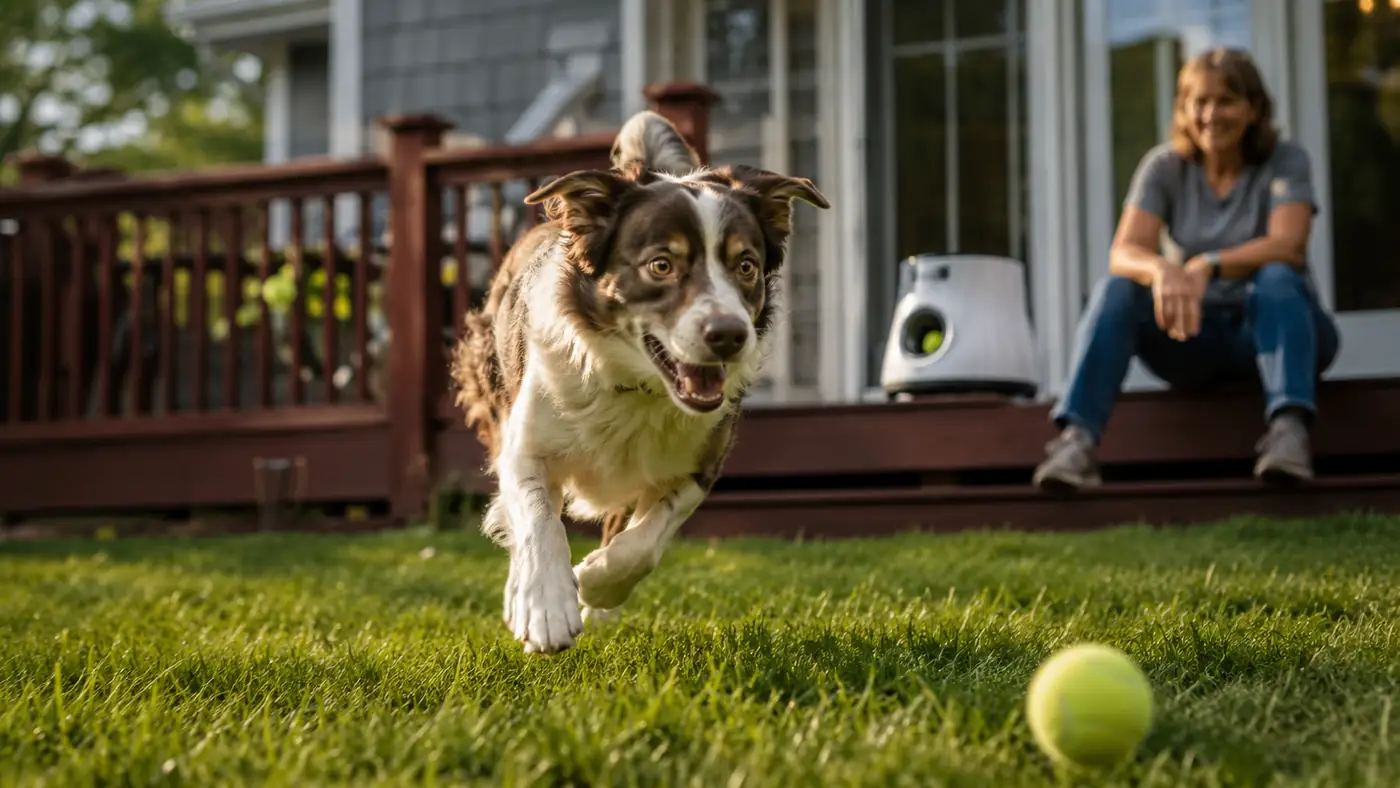
The whole reason I bought the MEKAPLE launcher was volume, and it delivers on that in a way my own arm never could. Gus needs somewhere between forty and sixty solid retrieves before he actually settles down for the rest of the day, and I simply cannot throw a ball sixty times without my shoulder complaining loudly by throw thirty. The launcher doesn't get tired, doesn't need a water break, and doesn't start short-arming the throws the way I do once I'm winded. I load fifteen mini tennis balls into the hopper, sit down in a lawn chair with my coffee, and Gus does laps until he's genuinely worn out instead of just bored of watching me stall between throws.
The three randomized distance settings turn out to matter more than I expected. A dog like Gus figures out a human's throwing pattern within a few sessions, he'll start anticipating where the ball is going and cutting the angle before it even leaves my hand. The MEKAPLE launcher mixes up the distance on each throw, so he actually has to watch and react instead of coasting on habit. That randomness is doing real mental work on top of the physical exercise, which is part of why a twenty-minute session with the launcher seems to tire him out more thoroughly than a twenty-minute manual session did.
Where Manual Fetch Wins
I'm not going to pretend the launcher is the right tool for every dog or every situation, because it isn't. Duke, my twelve-year-old senior, has zero interest in an automatic launcher. His fetch sessions are three or four gentle throws in the backyard before he wanders off to nap in the sun, and setting up a whole device for that is overkill. For a moderate-energy or senior dog, a plain plastic thrower does everything that's actually needed, costs next to nothing, and takes zero setup or charging. If your dog's idea of a good time is ten minutes then done, you don't need a machine solving a problem you don't have.
Manual fetch also travels in a way the launcher just doesn't. When I take Ranger and a foster dog to the park or we're out at a rest stop on a road trip, a chuck-style thrower lives in my jacket pocket and works on any patch of open grass. The MEKAPLE launcher needs a flat, stable surface and ideally a charged battery, which rules out spontaneous fetch sessions away from home. I learned this the hard way with a foster named Otis, a border collie mix with more energy than sense, when I packed for a weekend at my sister's place and realized the launcher wasn't practical for her small, sloped backyard. A five-dollar thrower would have solved that trip better than the seventy-dollar machine sitting uselessly in my trunk.
Got a dog who wears out your arm before your patience?
The MEKAPLE Automatic Ball Launcher is the one that finally kept up with Gus, three distance settings, a hopper full of balls, and no shoulder pain by the end of the session.
Amazon Check Today's Price on Amazon →What Actually Changed My Mind on This
I was skeptical of automatic launchers for a long time, mostly because I'd heard they were gimmicky, expensive plastic that dogs get bored of after a week. What changed my mind was watching how differently Gus behaved on launcher days versus manual days. On manual days, once my arm gave out, he'd still have energy left and spend the evening pacing and whining at the back door, looking for something to do. On launcher days, because the sessions could run twice as long without wearing me out, he'd actually flop down on the kitchen floor afterward and stay there. That's the real test for a high-energy dog, not whether he chases the ball, every dog chases the ball, but whether the session is long enough and varied enough to genuinely tap him out.
The flip side is that the launcher isn't magic for every temperament. A foster I had named Daisy, a nervous shepherd mix, was visibly startled by the mechanical whirring noise the first time it fired and wouldn't go near it for two full sessions. I ended up starting her on manual throws for a week to build up her confidence around balls in general before introducing the launcher slowly, letting her watch it fire a few times from a distance before she'd retrieve from it herself. If you've got a sound-sensitive or anxious dog, don't assume the launcher is a drop-in replacement for manual fetch on day one. It's a tool that some dogs need an introduction to, not a switch you can flip and walk away from immediately.
Cost Per Session, the Math I Actually Did
Before I bought the launcher I sat down and actually worked out whether it made financial sense over a five-dollar plastic thrower, because seventy dollars for a dog toy is not nothing. What tipped the math for me was frequency and consistency. I was already spending money on Gus's excess energy in other ways, a dog walker twice a week when I couldn't get outside myself, and the occasional replaced shoe or chewed baseboard on days he didn't get enough exercise. Once I priced out what a few months of dog walker visits cost against a single launcher purchase, the launcher paid for itself faster than I expected, and that's before factoring in what my shoulder was worth to me.
That math only works if your dog actually needs the volume. For Duke, running the same calculation would be silly, three throws a day for a senior dog doesn't add up to a dog walker bill or a chewed baseboard problem. Manual fetch, at minimal cost, is simply the more rational purchase for a dog whose exercise needs are modest. The launcher earns its price tag specifically through repetition, so if your dog wouldn't use those extra forty or fifty throws a day, you're paying for capacity you'll never touch.
Yard Size and Setup Realities
The MEKAPLE launcher's 30-foot max distance setting genuinely needs the yard space to back it up. My backyard is a decent suburban size and the longest setting works fine, but a foster family I know with a small fenced-in city lot found the top distance setting was actually too much, the ball was clearing the fence line before the dog could catch up to it, which meant they had to stick to the shortest setting most of the time and lost some of the value they were expecting. Manual fetch scales down naturally, you just throw shorter in a small yard, no settings to fuss with. If your outdoor space is genuinely tight, measure it before you buy the launcher and be honest about whether even the shortest setting gives your dog room to run without a wall or a fence in the way.
Durability and What Wears Out First
My launcher is about eight months into near-daily use and the motor housing itself hasn't shown any signs of strain, which surprised me a little given how much abuse Gus puts it through. The part I keep an eye on is the ball hopper opening, since a determined retriever dropping balls back in at speed can occasionally knock the unit slightly off its flat position, and it needs to be reasonably level to fire consistently. The mini tennis balls that come with it wear down faster than regular tennis balls, softer felt, more chew marks, and I've had to supplement with a second bag after a few months. A plastic manual thrower, by comparison, basically doesn't wear out. Mine from years ago is still functional, a little sun-faded, but it'll throw a ball just as well as the day I bought it.
Who Should Buy Which
Buy the MEKAPLE Automatic Ball Launcher if you've got a genuinely high-drive dog who needs more fetch than your arm can physically deliver, you have a yard with real room to back up the distance settings, and you're willing to spend a session or two introducing a nervous dog to the noise. It's the closest thing I've found to giving a dog like Gus the workout he actually needs without ending my day in a shoulder brace. Buy manual fetch, plain and simple, if your dog is senior, moderate-energy, or easily overwhelmed by mechanical noise, if you travel with your dog often, or if you just don't want another device to charge and store. Plenty of dogs, Duke included, are perfectly served by five minutes with a plastic thrower and don't need a machine solving a problem they never had in the first place.
Ready to stop being the bottleneck in your dog's fetch sessions?
If your dog outlasts your throwing arm every single day, the MEKAPLE Automatic Ball Launcher is built to keep the sessions going long after your shoulder would've tapped out.
Amazon Check Today's Price on Amazon →