
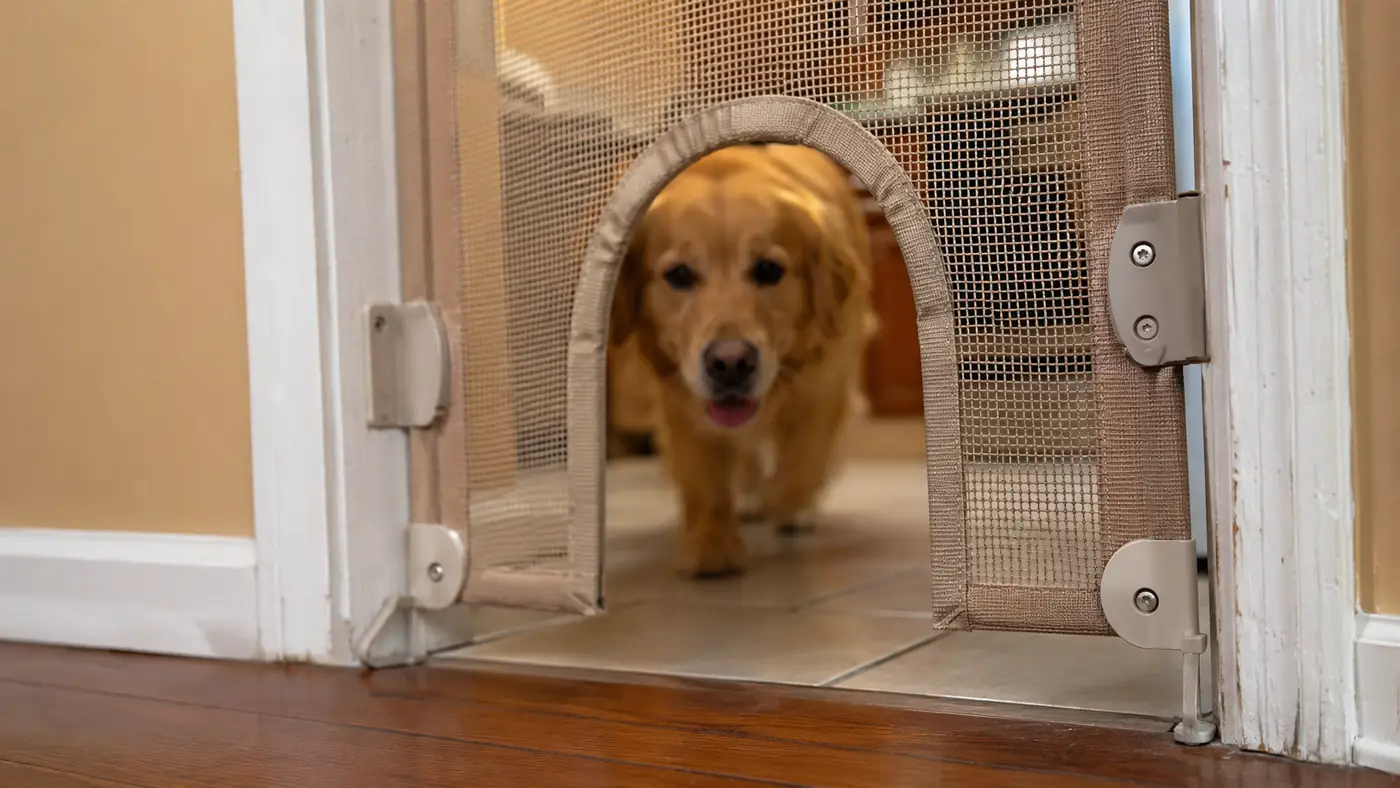
The one-year warranty on our Carlson extra wide walk-through gate expired back in June, which means I've now had enough time with this thing, and enough time watching it get tested by a rotating cast of foster animals, to tell you what the five-star reviews leave out. I wrote a full year-one review of this gate already, the setup, the daily walk-through door use, how it held up against eleven foster dogs. This is the part I didn't cover there. Once the newness wears off and the warranty card goes in the junk drawer, a few real quirks show up that only matter once you've lived with the gate for a while, not unboxed it.
Around month nine I bought a second Carlson gate, same model, for the top of our basement stairs, and that second install is where most of what I'm about to tell you actually surfaced. The kitchen doorway gate from my first review is a flat, low-stakes spot. The basement stairs are not. Putting the exact same gate in a spot where a mistake actually matters made me pay attention to things I'd glossed over the first time, the small pet door's real limitations, the honest tradeoffs of pressure mount versus hardware mount, what the mounting pads do to trim over time, and how clumsy the latch gets when your hands are full.
The Quick Verdict
Still a gate I'd buy again, but the small pet door, the mounting pads, and the one-handed latch all have real limitations that the packaging and most reviews gloss right over.
Amazon Check Today's Price →Before you buy the same gate twice like I did, know what changes at the top of a staircase.
A pressure mounted gate that's perfectly fine in a kitchen doorway is a different decision at the top of a stairwell. Check the current listing and specs before you decide where yours is going.
Amazon Check Today's Price on Amazon →How I've Used It
Right now we're running two of these gates at once, the original in the kitchen doorway and the newer one at the top of the basement stairs, where we store crates, cleaning supplies, and anything I don't want a curious foster puppy investigating unsupervised. Otis, a rat terrier mix we fostered for six weeks this spring, found the basement stairs within his first hour in the house and would have gone straight down them if the gate hadn't already been up. That's the gate doing its actual job, not the walk-through door convenience I talked about last time, but the harder job of keeping a fast, small, curious animal away from a real hazard.
The kitchen gate at this point is just furniture to us. Duke, our Lab, walks past it without a glance. The stairwell gate gets a different kind of attention, mostly from me, because I check the tension bar more often there than I ever bothered to in the kitchen. A gate that slips two inches in a doorway is an inconvenience. A gate that slips two inches at the top of a staircase is not something I'm willing to treat casually, warranty or no warranty.
The Small Pet Door Is Not One Size Fits All
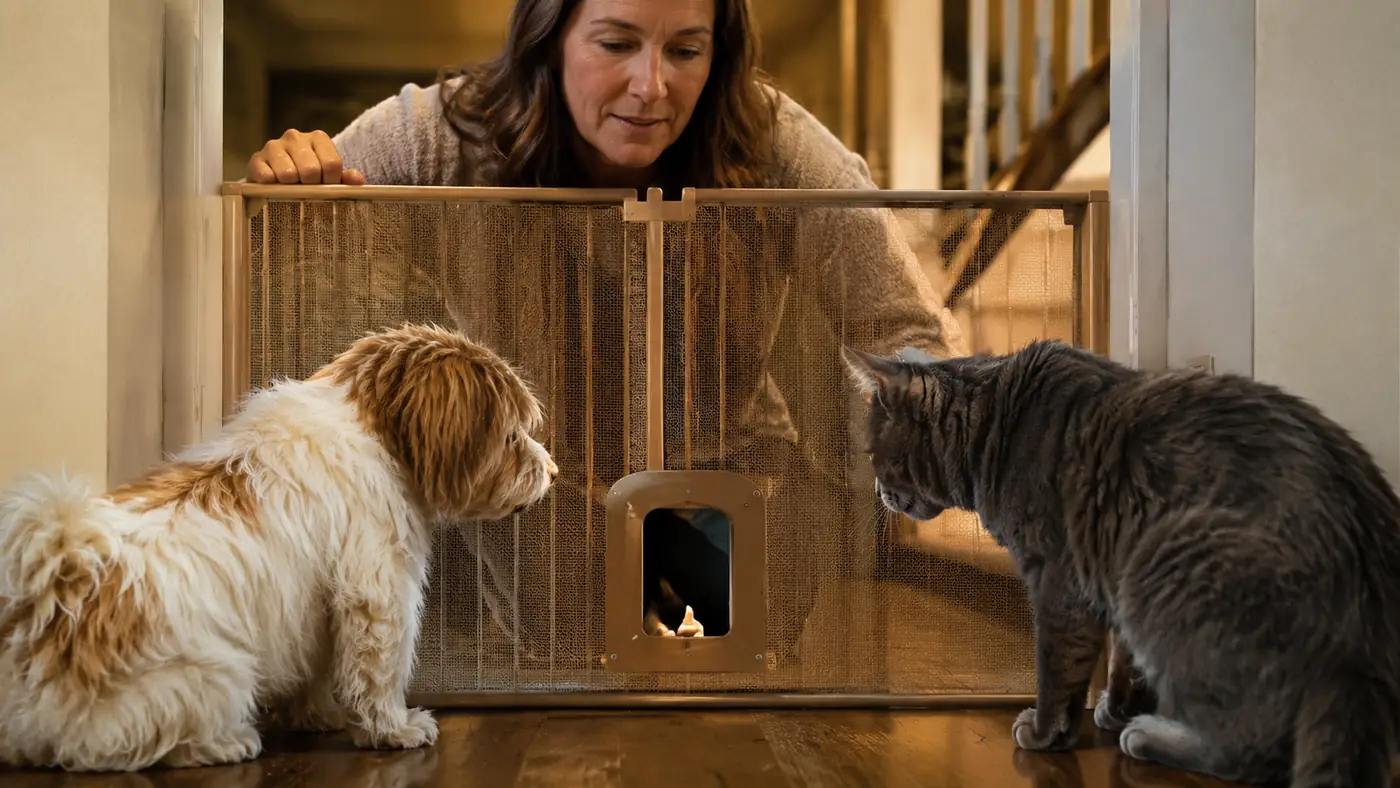
Biscuit, our senior cat, has used the small pet door cutout on the kitchen gate for a year now without a single issue. She's a lean fourteen-pound tabby, and the opening was clearly sized with a cat like her in mind. What I did not expect was how differently a small dog interacts with that same cutout. Pixie, a nine-pound Chihuahua mix we fostered over the winter, could technically fit through it, but she hesitated every single time, backing up and whining rather than pushing through the flexible flap the way Biscuit does without thinking twice.
I eventually figured out why. Cats lead with their whiskers and shoulders and read a gap almost instantly. Dogs, even small ones, tend to lead with their nose and hesitate at anything that closes around their body, and the cutout on this gate has just enough give in the flap material that it brushes against a dog's back on the way through in a way it never touches a cat's. Pixie eventually learned to use it after about two weeks of me propping it open with a rolled towel during the day, but it was never the instant, no-training solution for her that it has been for Biscuit.
Otis, the rat terrier mix, was worse. At roughly twelve pounds and built low and long, he got his shoulders through the cutout twice and got briefly stuck a third time, enough that I stopped letting him use it unsupervised and just lifted the whole gate open for him instead. If you're picturing this small pet door as a universal pass-through for anything under fifteen pounds, walk that expectation back. It's genuinely built for a cat-shaped animal, and a small dog with a different build is a coin flip at best.
Hardware Mount vs Pressure Mount: What the Box Doesn't Say
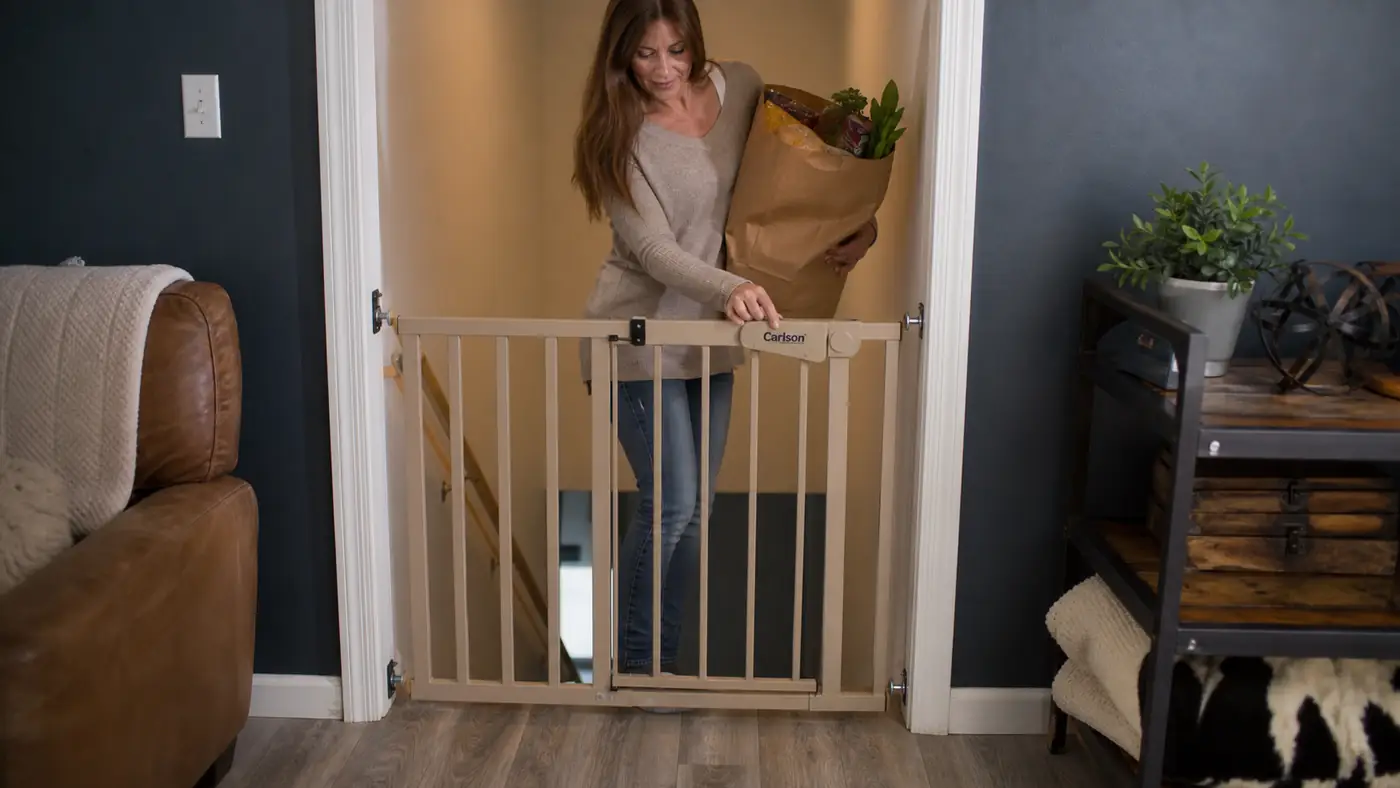
This gate ships as a pressure mounted gate, tension bar and rubber cups, no drilling required, and for a kitchen doorway that's genuinely fine. I said as much in my first review. What I didn't fully appreciate until I put the second one at the top of our basement stairs is how differently the safety math works once there's a real drop on the other side. Carlson, like most gate makers, sells a separate hardware mounting kit for exactly this reason, screws and brackets that turn the pressure fit into a permanent, drilled-in installation. I bought that kit for the stairwell gate. I did not buy it for the kitchen one, and I'd make the same call again for both.
Here's the part that annoyed me. The hardware kit is sold separately, it is not obvious from the main listing photos that you'll want it for a stairway installation, and the trim pieces around our stairwell doorway were narrower than the trim in the kitchen, which meant the brackets that came in the kit needed slightly longer screws than what was included. That was a Saturday morning trip to the hardware store I didn't plan for. Nobody tells you, before you buy, that the safest version of this gate for a high-stakes location requires a second purchase and possibly your own screws to finish the job right.
To be fair, once installed with the hardware kit, the stairwell gate has never budged, not once, even with Otis hitting it at a dead run twice in his first week. But I want to be honest that the pressure mount version, tension bar alone, is not something I would trust at the top of a staircase with a determined or large dog, regardless of how solid it feels when you first tension it in a doorway. The gate is the same. The stakes of where you put it are not, and the packaging doesn't push you toward that decision nearly hard enough.
What It's Done to Our Trim
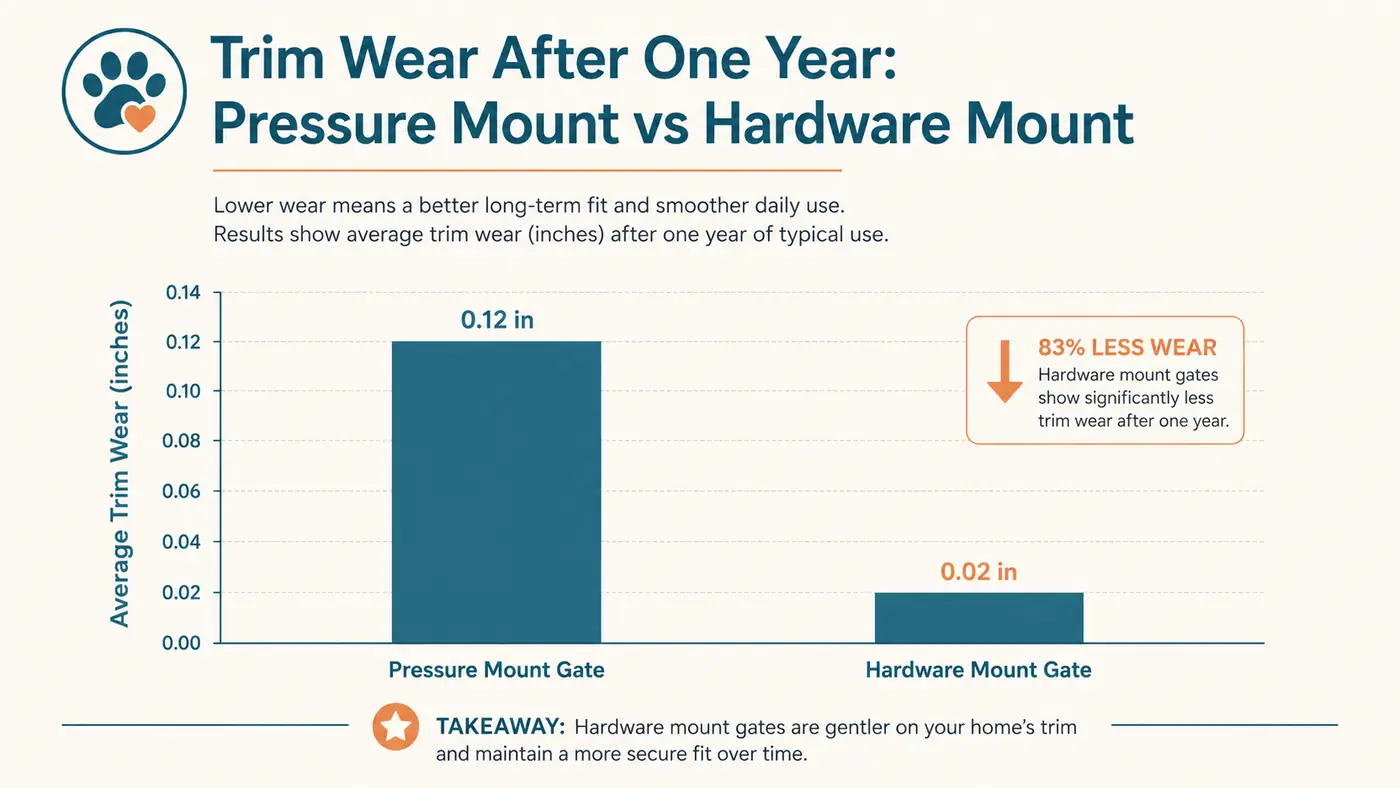
I did not expect to be writing a paragraph about trim damage, but here we are. The rubber cups on the pressure mount tension bar are gentle compared to a raw metal bracket, but they are not invisible. After a year in the kitchen doorway, there are two faint circular indentations pressed into the white painted trim on both sides where the cups sit, plus a thin scuff line where the bar itself has rubbed against the wood every time I've adjusted the tension. It's not damage you'd notice unless you were looking for it, but I was looking for it while photographing this review, and it's there.
The bigger issue came when I temporarily moved the kitchen gate to a different doorway for about three weeks last fall while we repainted. Repositioning the pressure cups left a slightly darker ring on the trim in the original spot, visible enough that I had to touch up the paint before I moved it back. If you plan to relocate this gate between doorways more than once or twice, plan on keeping a small can of matching touch-up paint on hand, because the rubber cups do leave a mark over time, especially on lighter painted trim.
The Latch, One-Handed, With Your Arms Full
The push-button latch on the walk-through door works fine when you have a free hand to actually look at what you're doing. It does not work nearly as well when you're balancing a laundry basket, a bag of dog food, or in my case most mornings, a to-go coffee mug and a leash at the same time. The button sits high on the panel and requires a specific inward-then-up motion that I can do without thinking after a year, but that took real practice, and it is not the kind of latch a first-time visitor, a dog sitter, or my mother-in-law figures out on the first try.
Tank, a seventy-pound foster we had for about a month last summer, made this worse by learning to lean his full weight against the door the second he heard me fumbling with the latch, which meant more than one occasion where I was trying to press a small button with one thumb while bracing the whole panel with my hip so he didn't shove through before it unlatched. It's a small annoyance in isolation, but it happens daily, and it is the one part of this gate that genuinely gets harder, not easier, the more animals and the more stuff you're juggling at once.
My honest workaround has been to just prop the door open during high-traffic stretches of the day, like the morning feeding rush, rather than fight the one-handed latch every single time. That defeats some of the point of a walk-through gate, but it's the trade I've made, and I think anyone buying this gate for a genuinely busy household should expect to make some version of that same trade too.
The Extension Kit Gotchas
Because our basement stairway opening runs a touch wider than even the gate's extended 36.5-inch max, I ended up ordering the separate extension kit to bridge the last couple of inches. Two things surprised me. First, the extension panel that arrived was a noticeably different shade of tan than the main gate, close enough that you wouldn't clock it from across the room, but standing right in front of it, the seam between the original panel and the extension is obvious. Second, the extension attaches with its own small hardware set that is fussier to align than anything on the main gate, and mine took two attempts to get level.
The extension also flexes slightly more than the main mesh panel when pressed, which makes sense structurally since it's a narrower add-on piece, but it's not something the product photos or the main listing prepare you for. If your doorway needs an extension to reach, budget the extra cost into your decision up front rather than assuming the base price gets you a perfect fit, and don't expect the seam to disappear the way it does in the marketing photos.
What I Liked
- Pressure mount is genuinely solid for low-stakes doorways like a kitchen, no drilling needed
- Hardware mount kit, once properly installed, has held firm through two full-speed hits from a foster dog
- Small pet door works essentially perfectly for a cat-shaped animal like our senior cat Biscuit
- Survived over a year of daily use across two separate installations without structural failure
- Extended width range meant we didn't have to abandon the brand even with an odd doorway measurement
Where It Falls Short
- Small pet door is unreliable for small dogs with different body proportions than a cat
- Hardware mounting kit needed for stairway safety is sold separately and not clearly flagged on the listing
- Pressure mount cups leave faint indentations and scuff marks on painted trim over time
- One-handed latch operation is genuinely awkward with your arms full, daily, not just occasionally
- Extension kit panel is a slightly mismatched shade and flexes more than the main gate
The gate itself hasn't let me down. What let me down was assuming the same setup that worked fine in my kitchen doorway would work exactly the same way at the top of a staircase without me doing any extra homework first.
Who This Is For
This gate is a strong pick if you have a wider-than-standard doorway, cats or genuinely small animals that need free movement through the small pet door, and a low-stakes location like a kitchen or hallway where a pressure mount is honestly sufficient. It's also worth it if you're willing to buy the hardware mounting kit separately for anywhere with real fall risk, like the top of a staircase, and treat that as part of the real cost rather than an optional add-on.
Who Should Skip It
If you're hoping the small pet door will work seamlessly for a small dog rather than a cat, temper your expectations, ours needed real training and one still got briefly stuck. If your hands are rarely free, think about how often you juggle groceries, kids, or multiple leashes, the one-handed latch will genuinely frustrate you day after day. And if you're mounting at the top of stairs, don't buy this expecting the pressure mount alone to be enough. Budget for the hardware kit from the start or look at a gate that ships hardware-mount by default.
A year and two installations later, I'd still buy it, just smarter this time.
Know which mount you actually need before you order, and check today's price and current listing details for the model and hardware kit that match your doorway.
Amazon Check Today's Price on Amazon →