
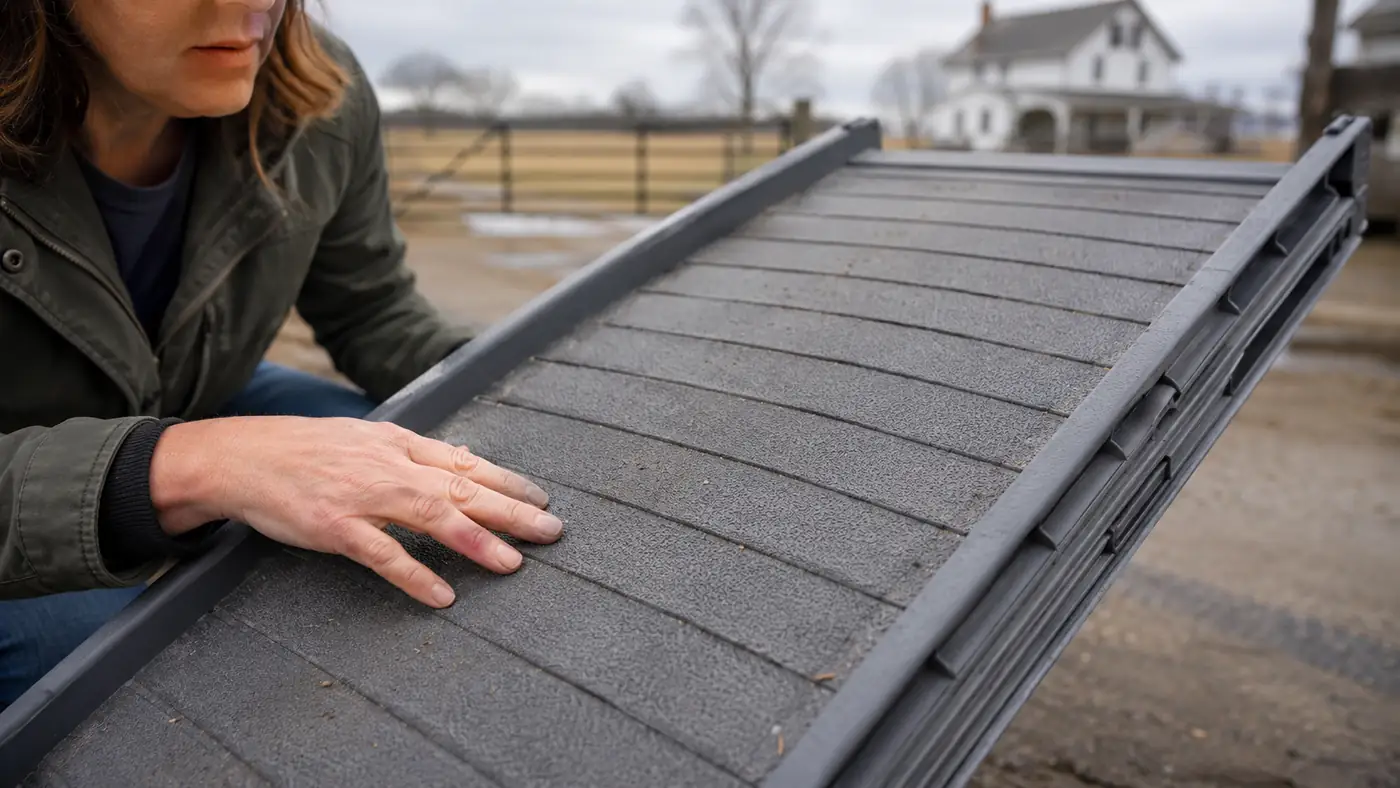
I read six five-star reviews of the PetSafe Happy Ride ramp before I bought mine, and not one of them mentioned that the center tread gets noticeably less grippy when a dog's nails haven't been trimmed in a few weeks, or that the printed weight rating and the weight a nervous 100-pound dog actually puts on a ramp mid-stride are two very different numbers. Fifteen years of fostering rescues out of Ohio has taught me that reviews written the first weekend after a purchase almost never catch what shows up months in. So here's what nobody told me before I bought mine, written after actually living with it.
For context, I'm the same person who wrote the long-term piece on this ramp built around our dog Duke, but this review isn't about him. This one is about everything that happened around the edges of that story: the ramp's behavior with a much heavier foster, a much smaller one, our fourteen-year-old cat Biscuit who wanted no part of any of it, and the two mornings the folding latch didn't do what I expected it to do. This spring and summer I had a hundred-and-five-pound mastiff mix named Tank living in my mudroom after a hoarding surrender, and a six-pound Chihuahua mix named Pixie who came through a few weeks after him. Both used this ramp. Both taught me something the product photos skip entirely.
The Quick Verdict
A genuinely useful ramp for average-size dogs on flat, dry pavement, but the weight rating, the traction, and the latch mechanism all deserve a closer look than the five-star reviews give them.
Amazon Check Today's Price →The Ramp Works. Here's the Part the Reviews Skip.
For most mid-size dogs loading on level pavement, the PetSafe Happy Ride does the job well. Check today's price on Amazon, then read the sections below on weight rating and traction so you're not surprised by anything six weeks in.
Amazon Check Today's Price on Amazon →How I've Actually Put It Through Its Paces
Between April and August I used this ramp with eleven different foster dogs plus my own two, and I started keeping a little notebook after the first month because I kept noticing things the online reviews hadn't warned me about. I loaded dogs into my husband's F-150 tailgate, my minivan's side door, and a friend's low hatchback, three very different heights and three very different surfaces, gravel driveway, asphalt, and a grass yard we use for meet-and-greets.
That variety mattered more than I expected. A ramp that behaves beautifully on a flat, dry driveway can behave completely differently on grass with a little give in it, or on gravel where the rubber feet at the bottom don't seat the same way. I wasn't testing this ramp to write a glowing recommendation. I was testing it because I hand this exact product to foster families who trust my judgment, and I wanted to know where it would let them down before they found out the hard way.
The short version is that it performed well most of the time, and the times it didn't were specific and predictable once I knew what to watch for. That's really the point of this piece. Not a rewrite of my long-term review, but the practical footnotes I wish someone had handed me before Tank ever set a paw on it.
The Traction Surface Nobody Photographs
PetSafe's product photos show a clean, dry ramp with a groomed golden retriever trotting up it in good light. What those photos don't show is how much grip depends on the condition of the dog's nails, not just the surface itself. Tank came to me straight off a hoarding case with nails that hadn't seen a trim in what looked like a year. His first few attempts on the ramp weren't graceful at all, his nails clicked and skated across the ridged tread instead of catching it, and for a dog that size and that nervous, that skidding sound made him bail off the ramp twice before I even got him halfway up.
Once his nails were trimmed down about ten days later, the exact same ramp felt like a completely different piece of equipment under him. That's not a flaw unique to this ramp, most textured surfaces work the same way, but it's genuinely not mentioned anywhere in the marketing copy or the reviews I read beforehand, and it's a real variable if you're bringing home a shelter or surrender dog whose nail care has been neglected.
The other traction issue is dirt buildup deep in the grooves of the tread, which isn't obvious from a quick hose-off. I noticed the center strip felt slightly less grippy by midsummer even after regular cleaning, and when I actually got down and scrubbed it with a stiff brush, there was packed grit sitting down in the texture that a garden hose alone hadn't been touching. It's a five-minute fix with a brush, but it's not something the box tells you to check for, and I'd guess plenty of owners never think to look.
The Weight Rating Is Technically True and Practically Misleading
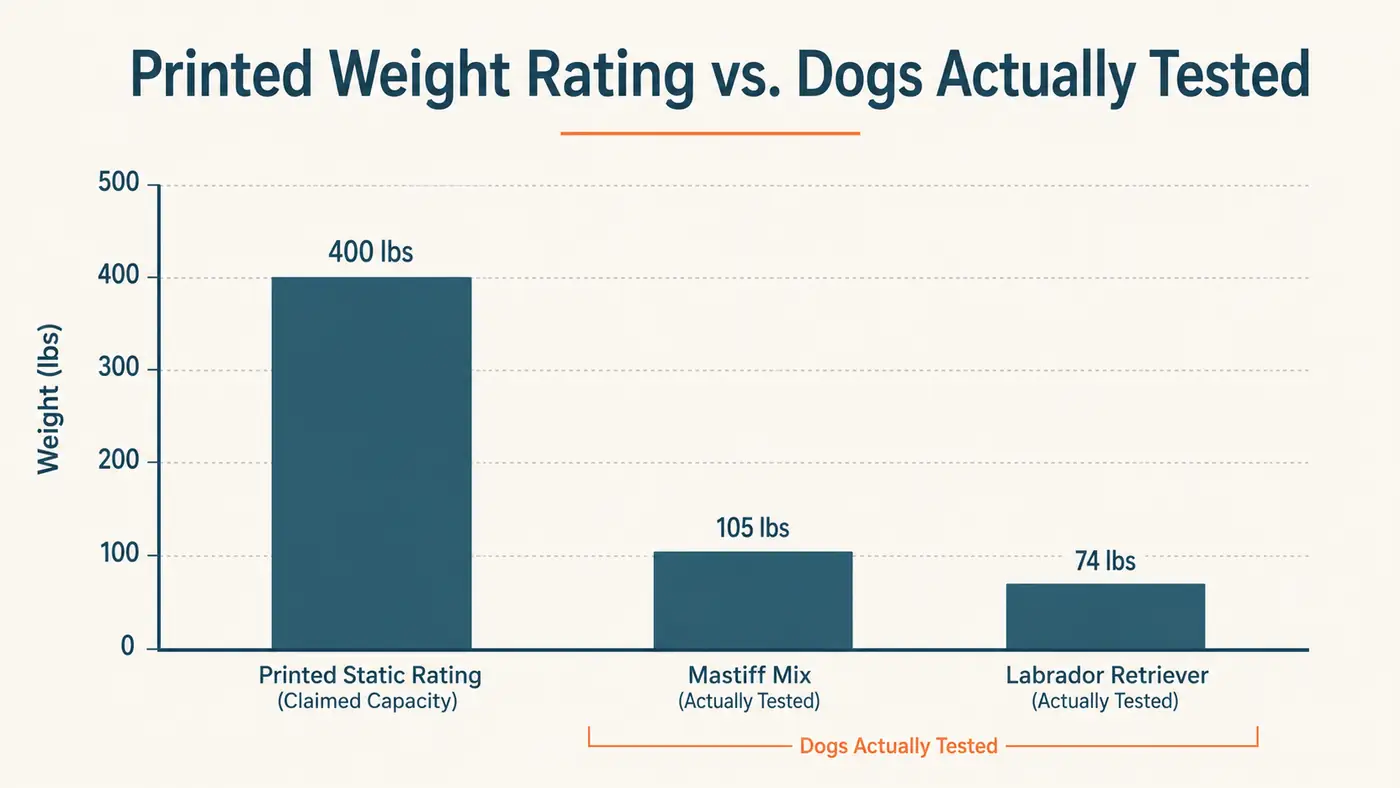
PetSafe prints a 400-pound weight capacity on this ramp's packaging, and as far as I can tell that number is accurate for a static, evenly distributed load, which is a fair way to test a ramp in a lab. It is not how a real dog uses a ramp. Tank at a hundred and five pounds is nowhere near that printed limit, but the first time he stepped onto the ramp with real momentum, nervous and moving fast to get the whole ordeal over with, I watched the panel visibly flex and bow under him, more than it ever did with Duke's steadier 74-pound stride.
That flex wasn't dangerous in our case, the ramp held, but it was noticeable enough that I stood closer and spotted him for the next several uses instead of letting him go up on his own the way I do with smaller, calmer dogs. A static weight rating doesn't account for a dog landing off-center, or a nervous dog taking the incline at a trot instead of a walk, both of which put uneven, dynamic force on one side of the panel rather than the calm centered load the rating assumes.
If you've got a genuinely large or giant breed dog, especially one who's anxious or unpredictable about new equipment, I'd treat the printed capacity as a ceiling you never want to approach, not a target you can load right up to. For Tank, once he trusted the ramp and started walking it calmly instead of rushing, the flex mostly disappeared. The behavior of the dog changes the math as much as the weight does, and that's the part no spec sheet can capture.
What Happens When You Put a Cat or a Very Small Dog on It
PetSafe's own listing title includes cats, and I want to be direct about this because it's the section I searched for and couldn't find before I bought mine: our cat Biscuit never used this ramp once, not for lack of trying on my part. I tried treats at the top, I tried standing at the bottom with her carrier open, I tried leaving it unfolded in the garage for a week so it would stop being a novel object. Cats don't reason about ramps the way dogs do, and a fourteen-year-old cat who's never needed one isn't going to start because I want a tidy anecdote for a review. If you're hoping this solves getting a reluctant cat into a car, it almost certainly won't on its own.
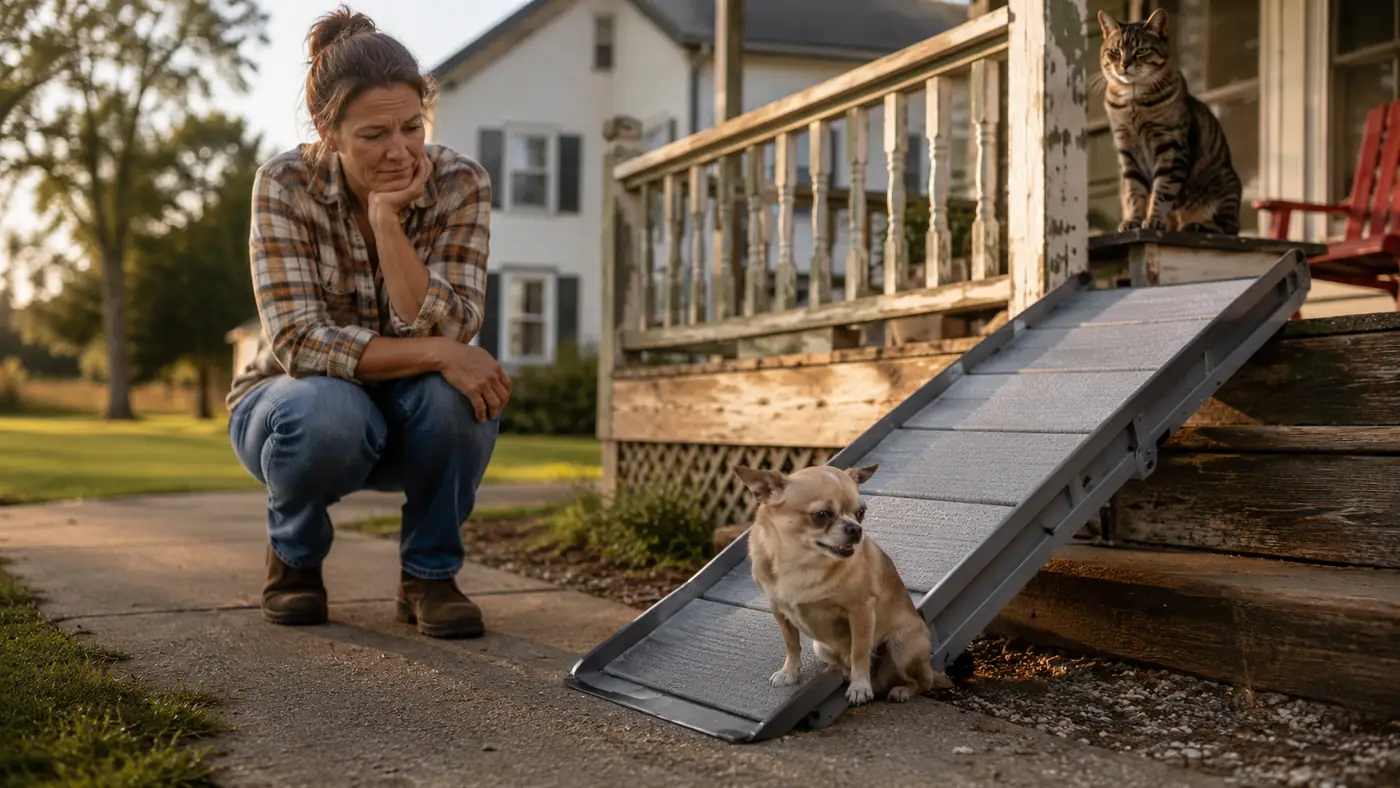
Pixie, the six-pound Chihuahua mix, was a different story but still not a simple one. The ramp's width isn't the problem for a tiny dog, there's plenty of room. The issue is the raised center seam where the ramp folds in half, which for Tank or Duke is a non-event, a small ridge their paws roll right over. For Pixie, that same ridge was tall enough relative to her stride that her front paws caught on it twice, and she started refusing to cross the middle section entirely, walking partway up and then backing down rather than stepping over the seam.
I ended up carrying her the first several times and only let her attempt it solo once she'd built confidence with me right beside her, guiding her paws over that seam by hand more than once. She uses it independently now, but it took real patience, more than any of the mid-size dogs I've run through this ramp, and I don't think a first-time owner would necessarily know to expect that from a product photographed almost exclusively with medium and large dogs.
Assembly and the Latch That Takes Getting Used To
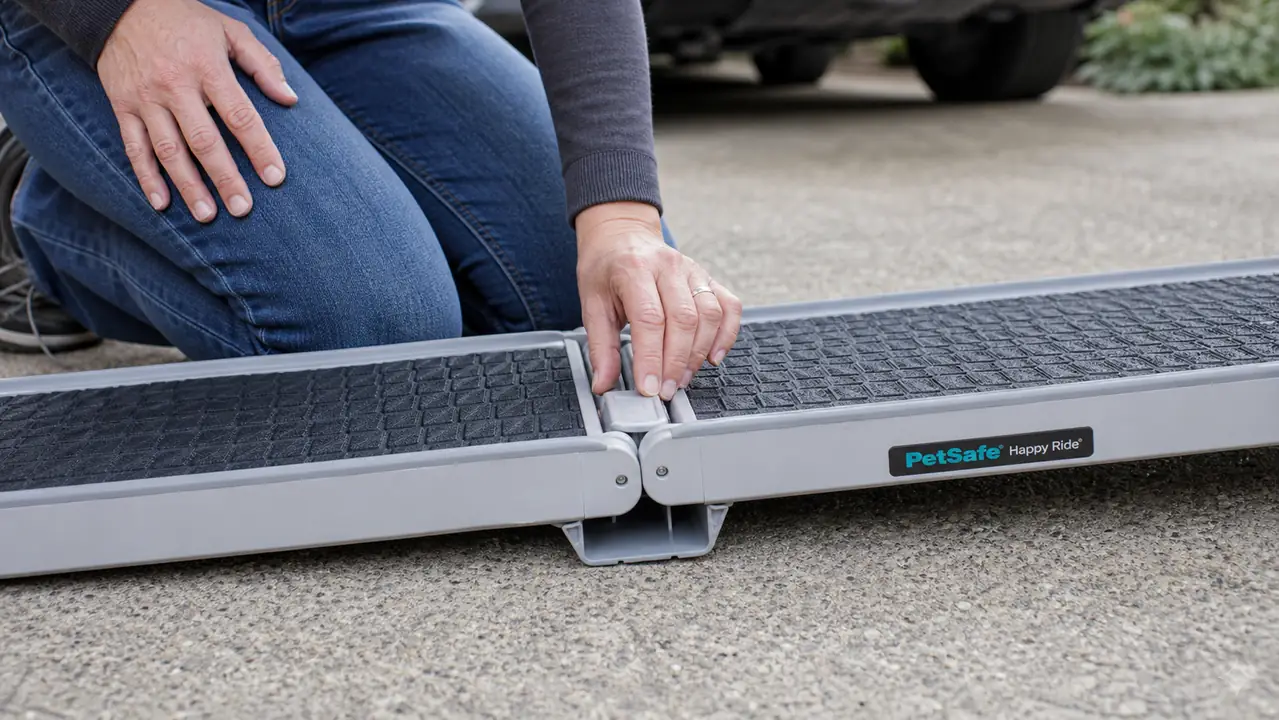
The ramp itself needs no tools, but the center hinge latch has a real learning curve that I don't see mentioned much. It locks with a spring-loaded pin that needs a firm, deliberate push to seat fully, and early on I had it look locked from a glance, flat, aligned, seemingly solid, when the pin hadn't actually clicked all the way into place. I found this out because a new volunteer at our foster intake used it without knowing to double-check, and the ramp shifted slightly underfoot while a dog was partway up it. Nobody got hurt, the dog just backed off startled, but it rattled me enough that I built a habit around it.
Now I do a firm two-handed push-and-listen check every single time before any dog steps on, not just a glance. It takes maybe three extra seconds. I mention this specifically because I've since talked to two other foster contacts who described the exact same false-lock moment when they first got theirs, so I don't think our experience was a fluke or a defective unit. It's a design quirk worth knowing about before you hand this ramp to someone in a hurry.
What the Marketing Photos Don't Show You
Every product photo I've seen for this ramp shows it on smooth, dry, flat pavement, usually a driveway on a sunny day. In four months of real use, I set it up on grass more times than I expected, at meet-and-greets, at a friend's house, at an outdoor adoption event, and the rubber feet at the base don't seat the same way on soft or uneven ground. On grass, especially after rain, the bottom edge can shift a half inch or so under a dog's weight if the ground isn't firm, which is enough to make an already nervous dog hesitate. On gravel it's steadier, but I always kick a flat spot clear first now rather than trusting the feet to find their own grip.
The other thing the photos never show is that there's no carrying strap or storage bag included, despite the ramp folding into a shape that looks like it's begging for one. I ended up buying a cheap bungee cord to keep mine folded shut in the garage after it kept popping partway open on the shelf. It's a minor thing, but at this price point I expected at least a strap, and I was mildly annoyed to be improvising one out of a bungee cord from my husband's toolbox.
What I Liked
- Welded aluminum frame feels solid and hasn't cracked or bent after months of rotating foster dogs
- Reasonable price for what you get compared to competing folding ramps
- Handles mid-size, healthy adult dogs on flat pavement very well once they trust it
- Folds compact enough to fit most trunks and SUV cargo areas
- Held up fine on a hundred-and-five-pound dog once he learned to walk it calmly instead of rushing
Where It Falls Short
- Traction quality depends heavily on the dog's nail length, which nothing in the marketing mentions
- Printed 400-pound rating is a static number and doesn't reflect a large, anxious dog's dynamic, off-center steps
- Center fold seam is a real obstacle for dogs under about ten pounds
- Latch can look locked without being fully seated, a real false-lock risk until you build the check habit
- No carrying strap or storage bag included
- Rubber feet lose their grip on grass or soft, uneven ground
The box says 400 pounds. What it doesn't say is that 400 pounds standing still and a nervous 105-pound dog landing off-center at a trot are two different tests, and only one of them made it onto the label.
Who This Is For
This ramp is a solid pick for owners with a mid-size, reasonably calm adult or senior dog who'll be loading on flat, paved ground most of the time, a driveway, a garage floor, a parking lot. It's also a fine choice for foster and rescue households like mine who need something durable and honestly priced that can be handed off between dogs without babying it. If you're willing to trim nails regularly, do the two-second latch check, and give a nervous dog a couple of weeks to build trust, it earns its spot.
Who Should Skip It
Skip it if you're hoping a ramp alone will solve getting a reluctant cat into a carrier or car, because in my experience it won't, cats need a completely different approach. I'd also steer owners of dogs under about ten pounds toward a ramp with a lower-profile fold or no center seam at all, and owners of very large, anxious dogs pushing close to the rated capacity should go in expecting some flex and plan to spot their dog rather than assume the printed number means rock-solid rigidity. And if most of your loading happens on grass, gravel, or uneven ground rather than pavement, budget extra patience for the footing.
Know What You're Buying Before It Arrives
The PetSafe Happy Ride is still a solid, honestly priced ramp for the right dog and the right driveway. Check today's price on Amazon and go in already knowing what the marketing photos leave out.
Amazon Check Today's Price on Amazon →